

Every cutting board material is a compromise. Wood is kind to knives and soaks up juice. Plastic is cheap and sheds into your food. Glass cleans perfectly and wrecks your edges. So where does metal land, and does titanium make a good cutting board or just an expensive one?
The way to answer that is not to list features. It is to work out what a board material actually has to do, then check titanium against each job. That is what this guide does, including the one place titanium comes second.
In this article
Key Takeaways
- Does titanium make a good cutting board? Yes, on three of the four things that matter, and it is honest about the fourth.
- It is non-porous, so juice sits on the surface instead of sinking into it.
- It stays chemically quiet. It does not react with food, and it never needs a coating.
- One board outlasts wood and plastic by decades, with no oiling and no warping.
- The trade is feel. Titanium is firmer than wood, so you hone your knives a little more often.
What Is a Titanium Cutting Board?

A titanium cutting board is a single sheet of food-grade metal, usually Grade 1 titanium. That is the purest commercial grade available. There is no coating on top, no glue in the middle, and no plastic filler.
That detail matters more than it sounds. Most cutting boards are assemblies. Wooden boards are strips glued edge to edge. Bamboo boards are pressed fibers held together with adhesive. Plastic boards are molded polymer that wears as you cut. A titanium board is one piece of one material, so there is nothing inside it that can separate, swell, or leach.
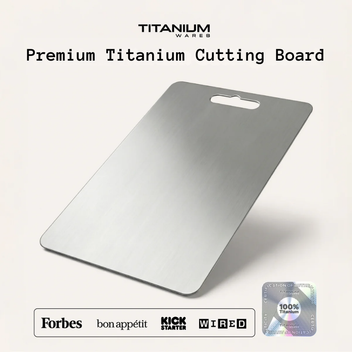
100% pure titanium cutting board: non-porous, no odors or stains, gentle on knives, dishwasher-safe. Free s...
Does Titanium Make a Good Cutting Board?

Yes, and here is the honest version of why. A board material has four jobs. It has to keep food out of itself, stay chemically quiet, survive thousands of cuts, and treat your blade reasonably. Titanium handles the first three better than almost anything in a home kitchen. It finishes second on the fourth.
Keep food out. Titanium has no pores and no grain. Chicken juice sits on the surface until you rinse it away. Wood pulls it in, and plastic traps it in knife grooves.
Stay chemically quiet. Titanium does not react with acid, salt, oil, or detergent. Leave a cut lemon on it overnight and nothing happens. It does not corrode and it does not leach into what you are cutting.
Survive thousands of cuts. It does not warp, crack, split, or rust. The surface picks up knife marks, but the board underneath stays flat and intact for decades.
Treat the blade reasonably. Here wood wins. Titanium is firmer, so edges dull a bit faster. It is still far gentler than glass or stone, which chip edges outright.
So the answer to does titanium make a good cutting board depends on which of those four you weight most. If hygiene and lifespan sit at the top of your list, nothing in a normal kitchen beats it. If pure knife feel is what you care about, wood still holds that crown.
For the buyer side of this question, including price and who regrets the switch, see Are Titanium Cutting Boards Good?
Benefits of Titanium Cutting Boards
Those four jobs turn into five practical benefits you notice in daily cooking. This is the part of does titanium make a good cutting board that shows up at the sink, not on a spec sheet.

Exceptional Durability
Titanium does not warp, crack, or split. A wooden board gives up somewhere between five and fifteen years, and only if you oil it. Plastic lasts one to three before the grooves make it worth replacing. A titanium board runs for decades on the same surface it shipped with.
We put real numbers on that in How Long Does a Titanium Cutting Board Last?
Hygienic and Non-Porous Surface
Cut raw chicken, rinse the board, move on to salad. Nothing soaked in, so nothing carries over. That is why a titanium board works as a bacteria resistant surface for raw meat and fish, and why most owners stop keeping a separate board for protein.
Easy Cleaning and Maintenance

Rinse, soap, sponge, dry. That is the entire routine. No oiling schedule, no conditioning, no special drying ritual. If you have ever left a wooden board three months without oil and watched it crack, you already know what that is worth.
The full routine takes about a minute, and we walk through it in How to Clean a Titanium Cutting Board
Rust and Corrosion Resistance
Titanium forms a thin oxide layer the moment it meets air, and that layer seals the metal. Water cannot get past it. Salt cannot get past it. Neither can tomato, vinegar, or dishwasher detergent. A board that never corrodes never releases anything into what you are cutting.
Lightweight Yet Strong
Titanium is about 43 percent lighter than steel by volume. You feel that every time you lift the board to the sink. A stainless board the same size is a two-handed job, and a thick end-grain wooden board is heavier still.
Potential Drawbacks of Titanium Cutting Boards
No material wins everything, and anyone asking does titanium make a good cutting board deserves the other column too.
Higher Cost
This is the main objection and it is a fair one. A titanium board costs several times what a basic plastic board costs. If money is tight this month, that gap matters more than any lifespan argument. The value only appears if you keep the board for years, which most people do.
Limited Availability
Titanium boards are still a young category. You will not find one in most supermarkets, and local kitchen shops often do not stock them. Most buying happens online, so you cannot pick one up and feel the weight before you pay.
There is a third trade-off worth naming: titanium is firmer than wood, so you will hone a little more often. We cover exactly how much in Do Titanium Cutting Boards Dull Knives?
Titanium vs Other Cutting Board Materials

Comparison is where does titanium make a good cutting board stops being theory. Here is how the three most common alternatives score on the same four jobs.
| MATERIAL | ABSORBS? | ADDS PLASTIC OR CHEMICALS? | LIFESPAN | KNIFE FEEL |
|---|---|---|---|---|
| Titanium | No | No | 10 to 30+ years | Firm |
| Wood | Yes | Oil and sealant wear off | 5 to 15 years | Softest |
| Plastic | In knife grooves | Yes, microplastics | 1 to 3 years | Soft |
| Glass | No | No | Until dropped | Harshest |
Titanium vs Wooden Cutting Boards
Wood feels better under a knife, and that is physics rather than nostalgia. The cost is upkeep. Wood needs oil, careful drying, and a permanent ban from the dishwasher. It also pulls juice into the grain, which is why many cooks keep a second board just for raw meat. Titanium skips all of that and still outlives wood by decades.
For the full side by side, read Titanium vs Wooden Cutting Board
Titanium vs Plastic Cutting Boards
Plastic is cheap, and that is most of its case. Every cut carves a groove, those grooves hold residue, and the surface sheds small plastic particles into food as it wears. You replace the board every year or two. Across a decade that is five or six boards, which quietly closes the price gap.
Titanium vs Glass Cutting Boards
Glass matches titanium on the first two jobs. It absorbs nothing and it is chemically inert. Then it fails the other two. Glass is far harder than blade steel, so edges dull within weeks and sometimes chip. It also slides on the counter and can shatter if you drop it. For anyone cooking on glass, titanium is an upgrade in every direction.
Who Should Consider a Titanium Cutting Board?

Consider one if you cook most days, handle raw meat or fish regularly, or have simply had enough of replacing boards. It suits small kitchens, because one board covers every job instead of three. Parents cutting plastic out of food prep usually land here for the same reason.
Skip it if you cook twice a month, if your budget is tight right now, or if the soft give of wood is something you genuinely enjoy. Those are good reasons. For everyone else, does titanium make a good cutting board is an easy yes.
Tips for Using a Titanium Cutting Board Safely
Titanium is low maintenance, not no maintenance. A few habits keep both the board and your knives in better shape, and they answer most of what people worry about when they ask does titanium make a good cutting board for daily use.
- Slice rather than chop. Let the blade move through the food instead of driving it down. Lighter marks on the board, less wear on the edge.
- Hone your knives regularly. A few passes on a honing rod between sharpenings is all the extra upkeep titanium asks for.
- Rinse before anything dries. Dried residue takes real scrubbing. Wet residue takes five seconds.
- Skip steel wool and scouring powder. Both leave fine scratches on the finish. A soft sponge handles everything.
- Dry it before storing. Titanium will not rust, but hard water leaves spots that are easier to prevent than remove.
- Rotate where you cut. Spreading the wear across the whole surface keeps one patch from marking faster than the rest.
- Do not use it as a permanent trivet. A hot pan set down briefly is fine. Leaving one there every night is not what the surface is for.
Why Titanium Wares Titanium Cutting Boards Stand Out

Plenty of listings use the word titanium. Fewer tell you the grade. Every Titanium Wares Cutting Board is made from Grade 1 food-safe titanium, with no coating, no resin, and no filler. Each one is SGS-tested, so the material claim comes with paperwork rather than adjectives.
The boards come in small, medium, and large. One size covers daily prep for most households. Two lets you keep raw meat and produce on separate surfaces without crowding the drawer. The finish stays smooth, rinses clean in seconds, and handles the dishwasher without complaint.
Conclusion
So, does titanium make a good cutting board? On the things a board material has to do, yes. It keeps food out of itself, it stays chemically stable, and it survives decades of daily cutting without oil, warping, or rust.
The honest caveat is knife feel. Wood is still the softest surface under a blade, and anyone who prizes that above everything else should stay with wood. Everyone else is trading a slightly shorter interval between sharpenings for a board that never needs maintenance and never has to be replaced. For most kitchens, that is a trade worth making.
For more helpful kitchen tips, follow us on Facebook and Instagram! If you have any questions about Titanium Wares products or promotions, contact us anytime at support@titaniumwares.com. Our 24/7 team is always happy to help.
Frequently Asked Questions
Does titanium make a good cutting board for everyday cooking?
Yes. For daily prep it handles raw meat, produce, and acidic food on one surface without staining or absorbing anything. Cleaning takes under a minute and there is no maintenance routine beyond washing and drying.
Is titanium better than stainless steel for a cutting board?
For home kitchens, usually yes. Both are non-porous, but titanium is roughly 43 percent lighter and softer than the steel in most knives, so it is easier to handle and gentler on blades. Lower grades of stainless can also develop rust spots over time, while titanium does not.
Will a titanium cutting board ruin my knives?
No. It is firmer than wood, so edges dull somewhat faster and you will hone more often. It will not chip or damage a well-made knife the way glass, stone, or ceramic can.
Do titanium cutting boards need oiling or seasoning?
No. There is nothing in the material to dry out or crack, so it needs no oil, wax, or conditioning. Some owners wipe on a little food-safe mineral oil purely for shine, but it changes nothing about performance or safety.
Why do knife marks show up on titanium?
Because titanium is softer than hardened knife steel. That is the same property that keeps it from chipping your edges. The marks sit on the surface, they do not open into grooves, and they do not affect food safety.

