

Titanium cutting boards are loved for their durability and hygiene. But after months of daily chopping, even the best ones start showing visible knife marks. So the natural question becomes: are scratched titanium cutting boards safe to keep using? It's a fair concern, especially since you paid premium for a board marketed as "long-lasting" and "food-safe."
The short answer is yes. Scratched titanium boards remain safe. The longer answer involves understanding why marks appear, what they mean for daily use, and how titanium compares to plastic and wood when scratches develop. This expert-backed guide walks through everything you need to know, from material science to practical care tips.
In this article
Key Takeaways
- Are scratched titanium cutting boards safe? Yes. The marks are cosmetic only. They don't compromise food safety.
- Titanium is naturally non-porous and bacteria resistant, so scratches don't trap bacteria like plastic grooves do.
- Titanium is chemically inert. It does not react with food, corrode, or leach into what you are cutting.
- Plastic sheds microplastics as it wears and wood absorbs moisture into the grain. Titanium does neither of those things.
- Minimizing knife marks comes down to knife type, technique, and routine board care.
4 Factors That Affect Knife Marks
Every cutting board eventually shows wear, but not all marks are equal. Four key factors determine how quickly and how deeply knife marks appear on a titanium board, and understanding them helps you keep your board looking newer for longer. These four factors also explain why people ask are scratched titanium cutting boards safe after only a few months of use.

Knife Type
The hardness and edge geometry of your knife play the biggest role in how titanium scratches. High-carbon steel knives (HRC 58 to 62) and ceramic blades cut deeper marks than softer stainless steel knives. Heavier chef's knives also leave more visible marks than lightweight paring knives. If you want to minimize scratches, a moderately sharp stainless-steel blade with a smooth slicing motion is gentler than a heavy carbon-steel cleaver. For more on how titanium interacts with various knives, see our guide on are titanium cutting boards bad for knives.
Cutting Style
How you cut matters more than how often. Rocking motions, common with curved European knives, produce shorter and denser scratch patterns. Push-cuts and pull-cuts (typical with Japanese knives) leave longer, cleaner marks. Chopping with downward force creates the deepest impressions because the knife edge presses harder into the surface. A controlled slicing motion will preserve your titanium board's finish far longer than aggressive chopping.
Board Finish and Thickness
Not all titanium boards are made equal. Thinner boards (under 1 mm) tend to show marks more visibly because the surface sits closer to the underlying structure. Thicker boards in the 1.2 to 2 mm range absorb impact better and look pristine for longer. Surface finish also matters: brushed or matte finishes hide scratches noticeably better than mirror-polished surfaces, which is why most premium titanium boards skip the high-gloss look.
Frequency of Use
A board you use three times a day will show wear faster than one you use occasionally. That's just physics. Every cut leaves a microscopic impression, and those impressions accumulate over time. Heavy users in busy kitchens should expect visible marks within months, while occasional cooks may not see noticeable wear for over a year. The good news: faster scratching doesn't mean faster degradation of the board's safety or performance. Heavy use changes how the board looks, not what it is made of. That is why the question are scratched titanium cutting boards safe has such a simple answer.
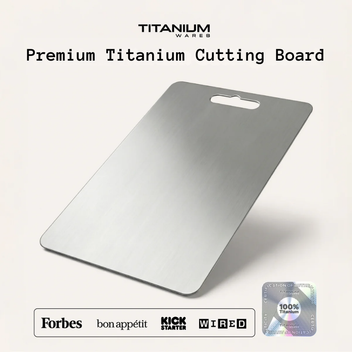
100% pure titanium cutting board: non-porous, no odors or stains, gentle on knives, dishwasher-safe. Free s...
Do Titanium Cutting Boards Show Marks Overtime?
Yes, all titanium cutting boards show knife marks over time. This isn't a defect or a sign of poor quality. It's a function of titanium being softer than the hardened steel used in most kitchen knives. The same property that makes titanium boards gentle on knife edges (titanium is the softer of the two metals in contact) is exactly what causes the marks to appear on the board surface.

It's worth noting that visible marks on titanium are different from the deep, bacteria-trapping grooves you see on heavily-used plastic boards. Titanium scratches are typically shallow surface impressions. They don't fracture or open up into crevices. The board surface stays smooth to the touch even after years of regular use. Marks are guaranteed, then. What matters next is the follow-up question most owners have: are scratched titanium cutting boards safe?
Are Titanium Cutting Board Scratches Safe?
Are scratched titanium cutting boards safe? Yes, and the reason sits in the material itself. This is the key thing to understand: titanium scratches do not open into grooves, do not trap residue the way worn plastic does, and do not change what the metal is. Even with extensive surface markings, the titanium itself remains non-porous, hypoallergenic, and biocompatible.

Compare this to plastic boards, where deep grooves become bacterial hotspots that even bleach can't fully reach. Or wood boards, where cuts in the grain absorb moisture and create perfect conditions for microbial growth. With titanium, the scratches are aesthetic only. Your food-safety profile stays intact for the entire lifespan of the board. For a deeper look at titanium's overall safety profile, see our detailed guide on are titanium cutting boards safe.
Titanium vs Plastic vs Wooden Cutting Boards: Health Comparison
The biggest health difference between cutting board materials shows up over time, after the surface starts to wear. Here's how titanium, plastic, and wood compare on the metrics that matter for food safety, household health, and long-term value.

Why Cutting Board Material Matters
Cutting boards have direct contact with every ingredient you eat. Material choice affects everything from bacterial growth to microparticle ingestion to chemical leaching. A board that's safe on day one might not be safe on day 365. Material choice determines how that wear curve looks over months and years of daily use. That curve is the real reason people ask are scratched titanium cutting boards safe, and why the same question gets a much worse answer for plastic.
Three things separate materials that stay safe over time from materials that don't: porosity (which determines bacterial harboring), particle shedding (which determines what ends up in your food), and chemical stability (which determines whether the material reacts with food or cleaning agents). Titanium scores well on all three. Plastic and wood don't.
Microplastic and Chemical Shedding
This is one of the most underrated risks of plastic cutting boards. Every time you slice on a plastic board, microscopic plastic particles release into your food. Research has shown that the average household plastic board can shed millions of microplastic particles per year. Those particles end up in food, then in the body.

Wood boards are more natural but can shed lignin, tannins, and absorb cleaning chemicals over time. Some wood treatments use mineral oils that don't pose safety issues, but lower-quality boards may use questionable finishes. Titanium behaves differently again. It is chemically inert, so it does not corrode, does not discolor and does not react with anything you cut on it.
Hygiene, Durability, and Cost Comparison Table Between Titanium, Plastic and Wooden
The table below summarizes how the three most common cutting board materials compare across the nine factors that matter most for everyday kitchen safety and long-term value.
Bacterial Resistance and Cleaning
Bacterial resistance scales directly with surface porosity. Titanium has effectively zero porosity at the macroscopic level, meaning bacteria, juices, and food particles can't seep into the surface. A quick wash with mild soap removes everything that touched the board. Porosity is the whole story here. Ask are scratched titanium cutting boards safe and the answer comes straight from that one property.
Plastic looks non-porous at first but develops microscopic grooves where bacteria thrive, especially after repeated knife contact. Wood is the most porous of the three, absorbing moisture and food residue into the grain. Even with diligent cleaning, wooden boards retain bacterial load that titanium and (fresh, smooth) plastic don't.
Particle Shedding Analysis
Recent studies on cutting board particle shedding have raised serious concerns about plastic boards in particular. A single chopping session on a plastic board can release thousands of microplastic particles into food. Over a year of daily use, this adds up to a measurable quantity of plastic consumed unintentionally. Researchers have linked these particles to a growing list of health concerns.
Wood boards shed wood fibers and lignin, though these are generally biodegradable and non-toxic in small amounts. Titanium loses a small amount of material too, because any surface a knife marks is giving something up. The difference is what that material is. Plastic particles are a synthetic polymer. Titanium is an inert metal that does not react with food.
Why Titanium Is Considered Chemically Stable
Titanium is one of the most well-studied biocompatible materials on earth. It's used in joint replacements, dental implants, bone screws, and pacemakers. These are places where the body has direct, long-term contact with the metal. Decades of medical research show that titanium does not trigger immune reactions, does not leach harmful ions, and does not accumulate in tissues the way heavy metals do.
That medical record is about implants rather than about anything you swallow, so it is not a direct answer to what happens on a cutting board. What it does establish is that titanium is an unusually stable and unreactive metal. On a board the practical consequence is the part you can actually observe: it does not corrode, it does not discolor, and acidic food leaves the surface unchanged. For anyone still asking are scratched titanium cutting boards safe over decades of use, medical research is the strongest evidence available.
Do Titanium Cutting Boards Shed Particles?
All cutting boards lose some material under knife contact. That is simply what a knife mark is. The useful question is not whether it happens but what each material is made of.

Titanium is no exception. A knife mark is metal that has been displaced, so a titanium board does give up a little material across its life. We have not seen a published measurement of how much, and we are not going to invent one. What is established is the chemistry. Titanium is inert, so it does not react with food. Plastic is a different case, because what it sheds is a synthetic polymer, and wood sheds fibers along with whatever treatment has been applied to the surface.
How to Minimize Knife Marks on Titanium Boards
While scratches are safe, many users still want to keep their titanium board looking pristine for as long as possible. Are scratched titanium cutting boards safe either way? Yes. The tips below are purely about appearance. Here are practical techniques that actually work:

- Use moderately sharp stainless-steel knives. They cut cleanly without leaving deep impressions.
- Slice rather than chop. Slicing motions create lighter marks than aggressive downward chopping.
- Don't lean weight onto the knife. Let the blade do the work; extra pressure deepens marks.
- Rotate the board's orientation. Distribute wear across the entire surface rather than always cutting in one spot.
- Hand-wash after each use. Dishwashers are safe, but daily hand-washing preserves the finish longer.
- Use both sides. Most quality titanium boards are double-finished. Flip occasionally to even out wear.
- Avoid bone or hard impacts. Hard impacts cause deeper marks than meat, vegetables, or fruit.
Upgrade Your Kitchen Safety With Titanium Wares Titanium Cutting Boards
If you're rethinking your cutting board lineup with health and safety in mind, Titanium Wares offers a Non-Toxic Cutting Board that addresses every concern raised above. The Grade 1 food-safe titanium surface is non-porous, biocompatible, and SGS-tested. That means no bacterial harboring, no microplastic shedding, and no chemical leaching, even after years of daily use.
For shoppers comparing options, our roundup of the best titanium cutting boards 2026 covers how Titanium Wares stacks up against other major brands in the category. And if you're still weighing whether the upgrade is worth it overall, our deep-dive on are titanium cutting boards good for daily home cooking covers the full benefit-vs-cost analysis.
Conclusion
To answer the question directly: are scratched titanium cutting boards safe? Yes. The marks are cosmetic only. Titanium's non-porous surface, biocompatibility, and chemical stability mean that visible scratches don't compromise food safety, bacterial resistance, or daily performance. In fact, titanium remains one of the safest cutting board materials available, even after years of heavy daily use.
If you're ready to upgrade your kitchen with a board that stays safe for decades, a Titanium Wares Titanium Chopping Board is the kind of investment that pays off every meal. No microplastics, no bacterial harboring, no warping. Just a clean, food-safe surface that's built to last through whatever your kitchen throws at it.
For more helpful kitchen tips, follow us on Facebook and Instagram! If you have any questions about Titanium Wares products or promotions, contact us anytime at support@titaniumwares.com. Our 24/7 team is always happy to help.
Frequently Asked Questions
Are scratched titanium cutting boards safe to keep using?
Yes. Scratches on titanium cutting boards are entirely cosmetic and do not affect food safety. Titanium remains non-porous, biocompatible, and bacterial-resistant even after extensive surface wear. The marks are visual only. Your board is just as safe to use after scratching as it was on day one.
Can bacteria grow in titanium cutting board scratches?
Titanium scratches are typically shallow surface impressions rather than deep grooves, and the underlying material remains non-porous. Bacteria need moisture and organic material to thrive, and titanium's smooth, non-absorbent surface offers neither, even within scratched areas. Standard washing remains fully effective at sanitizing the entire surface.
Should I replace my titanium cutting board when it gets scratched?
No. Replacing a titanium board because of scratches is unnecessary. The material remains structurally intact and food-safe regardless of cosmetic wear. Quality titanium boards from brands like Titanium Wares are designed to last for decades, with surface marks as a normal part of the aging process, not a sign of failure.
Do titanium cutting boards shed particles?
Every cutting board loses a little material where a knife marks it, and titanium is no exception. We have not seen a published measurement for how much, so we will not put a number on it. What can be said is the chemistry. Titanium is inert, so unlike plastic it is not a synthetic polymer, and unlike wood it carries no surface treatment that can wear off with it.
How can I make scratches on my titanium board less visible?
Using moderately sharp stainless-steel knives, slicing rather than chopping, hand-washing after use, and rotating the board's orientation all help minimize visible wear over time. Brushed or matte finish boards naturally hide scratches better than mirror-polished surfaces. Heavy scratches can sometimes be polished out, though it's generally not necessary for safety or performance.

