 Cutting Board
 Frying Pan Pro
 Double-Sided Board


Are titanium pans safe? Yes. A pan with a pure titanium cooking surface is one of the safest choices for your kitchen. Titanium is non-reactive, corrosion-resistant and so biocompatible it's used in medical implants, and with no coating there's no PTFE, PFOA or PFAS to worry about. The catch: not every "titanium" pan is the same. Some are simply non-stick pans with titanium in the coating. In this guide, Titanium Wares explains the three types you'll see, the real titanium cookware health risks, and how to check a pan before you buy.
In this article
Key Takeaways
-
Pure titanium is corrosion-resistant and biocompatible, which is why it is trusted in medical implants.
-
"Titanium" on a label can mean a pure titanium surface, a titanium-reinforced coating, or titanium-strengthened stainless steel.
-
Titanium metal (Ti) and the food additive titanium dioxide (E171) are different substances with different safety profiles.
-
The main real-world risks come from overheated PTFE coatings, damaged surfaces and, for some people, nickel in stainless steel.
-
Titanium Wares Titanium Pan Pro has a clearly stated construction, a transparent coating status and third-party lab testing you can check.
What Is a Titanium Pan? The 3 Types You'll See

Titanium cookware falls into three broad groups. They look similar online, but the surface that touches your food can be very different.
Pure Titanium Cooking Surface (Tri-Ply)
This is the type most people picture. The cooking surface is uncoated titanium, usually bonded to an aluminum core for heat spread and a stainless steel base for strength and induction compatibility.
Because the titanium layer itself is the cooking surface, there is no non-stick coating to chip, flake or wear off over time. Food touches titanium, not a synthetic finish.
"Titanium-Reinforced" Non-Stick (PTFE or Ceramic Coating)
Here, titanium is an ingredient, not the surface. Titanium particles are mixed into a non-stick coating to make it tougher and more scratch-resistant.
The layer your food touches is still PTFE or a ceramic coating. Its safety depends on the coating formula, how it was applied, its current condition and how hot you cook with it.
Titanium-Bonded or Titanium-Strengthened Stainless Steel
These pans are mainly stainless steel. Titanium may be added to the alloy, used as a surface treatment or bonded into the structure, depending on the design.
The cooking surface is usually still stainless steel. Its corrosion resistance and metal-release profile should be judged by the actual steel grade and construction. It is a stainless steel pan with titanium in the mix, not a pure titanium pan.
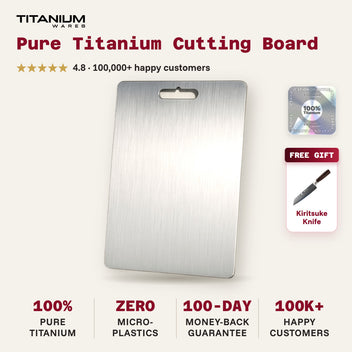
A pure titanium cutting board that never soaks up juices, stains or smells. Rinses clean or goes in the dis...
Is Titanium Safe to Cook With?
For a genuine titanium cooking surface, the material science is reassuring. Here's why.
Biocompatibility: Why Titanium Is Used in Implants
Titanium and its alloys are a first choice for hip replacements, dental implants and bone plates. They resist corrosion, and the body tolerates them very well.
The reason is a thin oxide layer that forms naturally on titanium’s surface when it meets oxygen. As a 2022 review in Science and Technology of Advanced Materials explains, this passive film, just a few nanometers thick, shields the metal from its surroundings and limits chemical reactions. If it is scratched, it re-forms on its own.
Does Titanium Leach Into Food?
Metal leaching (or "migration") is when small amounts of a material move from cookware into food. It tends to rise with acidic ingredients, long cooking times and worn surfaces.
Titanium's protective oxide layer makes it highly resistant to this kind of corrosion. It reacts far less readily than many common cookware metals, so acidic ingredients like tomatoes, wine and citrus are not a problem. On an uncoated titanium surface, they won't leave a metallic taste or discolor the pan.
Titanium vs Titanium Dioxide (E171): Clearing Up the Confusion
Some confusion around titanium safety comes from titanium dioxide (TiO₂), a compound once widely used as the food coloring E171.
However, titanium metal (Ti) and titanium dioxide (TiO₂) are chemically different substances with different properties and uses.
In 2021, the European Food Safety Authority (EFSA) concluded that E171 could no longer be considered safe as a food additive because concerns about potential genotoxicity could not be ruled out. This led to its removal from the EU’s approved food additive list.
This finding concerns titanium dioxide consumed as a food additive, not solid titanium metal used as a cookware surface. The two should not be confused when evaluating cookware safety.
Titanium Cookware Health Risks: What to Actually Watch For
Most real-world risks don't come from titanium itself. They come from what's on top of it, what's underneath and how the pan is used.
Coatings Sold as "Titanium" (PTFE, PFAS)
Some pans marketed as titanium still rely on a PTFE non-stick coating. PTFE is a fluoropolymer and part of the wider PFAS chemical family, and non-stick coatings are one of the PFAS uses the FDA has authorized for food contact.
Used as directed, PTFE cookware is generally not considered dangerous. Germany’s Federal Institute for Risk Assessment (BfR) says no adverse health effects are expected from properly used PTFE-coated pans.
The key exception is overheating. BfR notes that PTFE can begin to decompose at around 360°C (680°F), releasing harmful fumes, which is why coated pans should never be heated empty.
What's Under the Surface: Aluminum Core and Stainless Base
An aluminum core or a stainless steel base doesn't make a pan unsafe. These layers are there for performance: aluminum spreads heat quickly and evenly, while stainless steel adds strength and makes the pan work on induction.

Tri-Ply Titanium Pan Construction
What matters is whether those layers are fully enclosed, whether they could touch food in ways the design doesn't intend and whether the finished pan meets food-contact requirements. Health Canada's guide to safe cookware use is a helpful reference on how substances can move from cookware into food.
Nickel Sensitivity
For people with a nickel allergy or sensitivity, nickel is worth a closer look. Many common stainless steels, such as 18/8 or 18/10, contain nickel.
How much nickel can move into food depends on the steel grade, the surface condition, the food and the cooking conditions. If you're sensitive, check which material forms the cooking surface and what any steel layers are made of, and ask for test reports when needed.
Overheating an Empty Pan
Leaving an empty pan on high heat for a long time is a bad habit with almost any cookware.
With PTFE-coated pans, it is the main safety risk, since an empty pan can reach decomposition temperatures quickly. With uncoated metal surfaces like titanium, the PTFE warning doesn't apply in the same way. You should still follow the maker's temperature guidance to protect handles, bonded layers and the pan's shape.
Good heat control is simply a safe cooking habit: preheat briefly, add oil or food, and adjust from there.
Titanium vs Non-Stick, Stainless Steel, Cast Iron and Ceramic: Safety Compared
Every common cookware material can be safe when it's well made and used correctly. Each one has its own point to keep in mind:
|
Cookware material |
Main safety consideration |
|
Titanium cooking surface |
Highly corrosion-resistant and non-reactive; confirm construction and seller information |
|
PTFE non-stick |
Very convenient release; Be careful not to overheat an empty pan, as this may pose health risks |
|
Stainless steel |
Durable and widely used; nickel can matter for sensitive users |
|
Cast iron |
Excellent heat retention; can add iron to food, especially with acidic dishes |
|
Ceramic-coated |
Easy release; check coating composition, wear and testing (a coating is not solid ceramic) |
No material is automatically the safest in every situation. Product quality and how you use it matter as much as the material.
That said, if you want a durable surface with no non-stick coating to wear off and very low reactivity with food, a pure titanium pan is a compelling choice. Just buy from a seller that clearly states the construction, so you don't end up with a coated or imitation "titanium" pan.
How to Check a Titanium Pan Is Really Non-Toxic
A few simple checks will tell you far more than the word "titanium" on the box.
Third-Party Lab Tests (SGS)
Independent testing is one of the clearest signs that a brand stands behind its materials. SGS is one of the world's best-known testing and inspection companies, so its name on a product carries real weight.
When a brand mentions lab testing, look for it on the product page itself, tied to the specific pan and material, not just a generic claim on the homepage. It also helps to know that tests can cover different things, from confirming the material to checking food-contact safety.

The Titanium Pan Pro from Titanium Wares is SGS-tested, with a food-grade, 100% pure titanium cooking surface. If independent verification matters to you, it's a pan you can choose with confidence.
PFAS, PTFE and PFOA-Free Claims
These three terms are related, but they are not interchangeable:
-
PFAS: A large family of thousands of fluorinated chemicals.
-
PTFE: One specific PFAS polymer, the classic non-stick coating.
-
PFOA: A chemical once used to make PTFE, now largely phased out.
So "PFOA-free" does not mean "PFAS-free." A PFOA-free pan can still have a PTFE coating. The simplest way to avoid fluoropolymers is a pan with no coating at all.
That's exactly how the Titanium Pan Pro is made. Its cooking surface is uncoated pure titanium, free of PFAS, PTFE and PFOA, with no ceramic sol-gel coating either.
FDA and LFGB Food-Contact Compliance
The U.S. FDA regulates substances that come into contact with food. It does not issue a general "FDA-approved" seal for individual pans. A claim of FDA compliance means the maker states its materials meet the relevant FDA food-contact requirements.
LFGB refers to Germany's Food and Feed Code, which sets legal requirements and testing for food-contact materials sold in Germany.
The strongest picture comes from a compliance statement backed by independent testing. The Titanium Pan Pro brings both together: it is FDA-compliant and SGS-tested, and its non-reactive titanium surface is safe for acidic foods like tomato sauce, wine and citrus.
How to Use a Titanium Pan Safely
A few habits keep any pan performing well and safely:
-
Read the manufacturer's temperature and care instructions.
-
Avoid prolonged empty preheating, especially with coated cookware.
-
Use suitable utensils to avoid unnecessary surface damage.
-
Clean the pan according to its material and coating.
-
Stop using cookware with severely damaged or peeling coatings.
The Bottom Line
Titanium has genuinely useful properties for cookware: strong corrosion resistance, very low reactivity and a long record of safe use in medicine. But the word “titanium” on a label doesn’t prove a pan is safe. A pan you can trust tells you exactly how it’s built, makes its coating status clear (ideally no coating on the cooking surface) and has lab testing you can check.


The Pure Titanium Pan Pro is a reliable choice for all modern cooktops and everyday cooking needs.
The Pure Titanium Pan by Titanium Wares checks every one of those boxes, so you can cook every day without worrying about what ends up in your food. Shop the Pure Titanium Pan today and bring a safer, longer-lasting pan into your kitchen.
For more helpful kitchen tips, follow us on Facebook and Instagram! If you have any questions about Titanium Wares products or promotions, contact us anytime at support@titaniumwares.com. Our 24/7 team is always happy to help.
FAQs
Is titanium cookware toxic?
Pure titanium cooking surfaces are not considered toxic. Titanium is highly corrosion-resistant and biocompatible, so it reacts very little with food. The bigger question is what the "titanium" label covers. If titanium is only reinforcing a PTFE or ceramic coating, that coating is what touches your food, so its formula and condition matter more than the titanium.
Can titanium cookware cause cancer?
There is no established evidence that metallic titanium cookware causes cancer. Cancer concerns linked to titanium usually involve titanium dioxide: EFSA's 2021 concern about the E171 food additive, and IARC's "possibly carcinogenic" listing, which relates to inhaling TiO₂ dust.
Is titanium safer than stainless steel?
Both are widely used and considered safe when well made. A pure titanium cooking surface has two practical advantages: it is very non-reactive and contains no nickel. That makes it appealing if you cook many acidic dishes or are sensitive to nickel. Stainless steel remains a durable, trusted option for most households.
Are titanium frying pans safe at high heat?
Uncoated titanium handles high heat well, and the PTFE overheating warning does not apply to it the same way. Still, the pan's real temperature limit depends on its full construction, including bonded layers and handles. For titanium-reinforced non-stick pans, follow coating guidance and never heat them empty. Always check the maker's stated limit. The Titanium Pan Pro, for example, is oven-safe up to 500°F (260°C).
Are titanium pans safe for people with a nickel allergy?
Titanium itself contains no nickel, so a pure titanium cooking surface is a good fit for many nickel-sensitive cooks. In tri-ply titanium pans, stainless steel usually forms the exterior, not the surface your food touches. If your sensitivity is severe, ask the seller which steel grade is used before you buy.

