 Cutting Board
 Frying Pan Pro
 Double-Sided Board


Are titanium pans good? Yes, if you want a coating-free metal pan that is light, tough and built to last, and you're willing to learn a little heat control. They're not the right pick if you expect eggs to glide around with zero oil. In this guide, Titanium Wares will walk you through the real pros, the honest cons, and what our kitchen tests showed about non-stick performance.
In this article
Key Takeaways
-
Titanium pans have no coating, so there's no PTFE, PFOA or PFAS to wear off.
-
They aren't coated non-stick pans. Food releases through preheating, a little oil and good timing.
-
Tri-ply construction is what gives a titanium pan even, reliable heat.
-
The upfront price is higher, but there's no coating to replace every few years.
-
If you cook every day and prioritize health-conscious kitchen tools, the Titanium Wares Titanium Pan Pro is made for you.
What Makes Titanium Pans Different?
Most "titanium" pans on the market fall into one of two groups, and the difference matters:
-
Pure titanium surface: A solid layer of titanium is the cooking surface itself. There's no coating on top, so nothing can peel, flake or wear away.
-
Titanium-coated or "titanium-infused": Titanium particles are mixed into a non-stick coating over an aluminum body. It behaves like a regular coated pan and wears out the same way.
Titanium itself is strong, light and corrosion-resistant. It's also non-reactive, so tomato sauce, citrus, wine and vinegar won't pick up a metallic taste or damage the surface.
The Titanium Wares Titanium Pan Pro belongs to the first group. It bonds a pure titanium cooking surface to an aluminum core and a stainless steel exterior, so you get a clean titanium surface plus the even heat titanium can't deliver on its own.

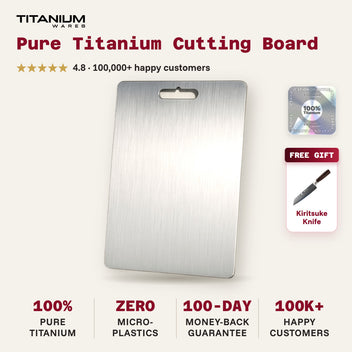
A pure titanium cutting board that never soaks up juices, stains or smells. Rinses clean or goes in the dis...
Pros of Titanium Pans
No Coating, No PFAS, PTFE or PFOA
The cooking surface is bare metal, so there's no coating to chip, peel or break down over time. Titanium is non-reactive, which makes it a great fit for acidic dishes like marinara or lemon-butter sauce. For the full safety picture, read our guide: Are Titanium Pans Safe?
Scratch-Resistant: Metal Utensils Are Fine
Titanium is a hard surface, so metal spatulas and tongs won't ruin it. Light scratches are cosmetic only. With no chemical layer underneath, there's nothing harmful to expose. In contrast, using metal spatulas with nonstick-coated pans can scratch and damage the coating, affecting not only the pan's performance but also potentially your health through food contamination.
Lighter Than Cast Iron and Most Stainless
The Titanium Pan Pro weighs about 2 lb, and titanium pans can be up to 45% lighter than comparable stainless steel. Lifting, tossing and pouring are easier on your wrists, which is a real plus for older cooks.
Works on Every Cooktop and in the Oven
The stainless steel exterior makes it induction-ready, and it works on gas, electric and ceramic too. It's oven-safe up to 500°F, so you can sear on the stove and finish in the oven.
Easy to Clean, No Seasoning
Warm water, mild soap and a soft sponge are all it takes. Titanium doesn't rust, so there's no oiling or careful drying like cast iron or carbon steel. Most titanium pans are dishwasher-safe, but always follow the manufacturer's care instructions.
Cons of Titanium Pans
No pan is perfect. Here's what to expect, and how to work around each point.
A Short Learning Curve With Heat
Titanium heats up fast and cools down fast. If you're used to Teflon, you might crank the heat right away or add food to a cold pan, and that's when food sticks.
The fix is simple: preheat on medium for 2–3 minutes, add oil, then add food. Most cooks get the hang of it within a week.
Not as Slick as Teflon
Without any oil, eggs will stick. But once the pan is properly preheated and lightly oiled, everyday cooking goes smoothly.
The trade-off works in your favor. Titanium sears better and builds fond, the browned bits that turn into a rich pan sauce.
Higher Upfront Price
A quality titanium pan costs more than a basic coated pan. You're paying for premium metal and tri-ply construction, though, and there's no coating to wear out. Spread across years of daily cooking, one titanium pan often costs less than replacing cheap non-stick pans again and again.
Heat Tint and Discoloration
Blue, gold or rainbow tints can appear after high-heat cooking. This is harmless heat oxidation, a cosmetic change that doesn't affect safety or performance.
A wipe with equal parts white vinegar and water, or a gentle cookware cleaner, usually brings the shine back.
Titanium Alone Heats Unevenly, Which Is Why Tri-Ply Matters
Pure titanium is a poor heat conductor on its own. A single-layer titanium pan can develop hot spots that burn one side of a pancake and leave the other pale.
That's why quality titanium pans use:
-
An aluminum core to spread heat evenly
-
A stainless steel exterior for strength and induction compatibility
Skip cheap single-layer pans and anything vaguely labeled "titanium-infused." The Titanium Pan Pro uses full tri-ply construction for exactly this reason.
Are Titanium Pans Really Non-Stick?
Not in the Teflon sense. Titanium pans have no non-stick coating. Instead, they release food naturally when the pan is hot enough and lightly oiled.
How a Textured Titanium Surface Releases Food
Up close, a metal cooking surface has tiny peaks and pores. When the pan is properly preheated, a thin film of oil fills those gaps and forms a layer between the food and the metal.
Proteins like eggs, chicken and fish grab the surface at first, then let go once a golden sear forms. Move them too early and they tear. Wait a few seconds and they release on their own.
Our Egg, Pancake and Salmon Test
These three foods are where most people judge a pan. Here's the heat, oil and timing that worked with the Titanium Pan Pro:
|
Food |
Heat |
Oil |
What to Expect |
|
Fried eggs |
Medium-low after preheating |
½–1 tsp butter or oil |
The egg slides free once the white turns opaque |
|
Pancakes |
Medium |
A light wipe of oil |
The first pancake may grip slightly; the rest release cleanly |
|
Skin-on salmon |
Medium-high |
1 tsp high-smoke-point oil |
The skin sticks at first, then releases once crisp, about 3–4 minutes |
The takeaway: heat and timing matter more than any coating.

Titanium Pan Pro cooking test with fried eggs pancakes and crispy salmon
The Preheat and Water-Drop Test
Not sure when your pan is ready? Try this:
-
Preheat the empty pan on medium for 2–3 minutes.
-
Add a few drops of water.
-
Read the result:
-
Water sizzles and evaporates: not hot enough yet.
-
Water beads into small balls and glides across the surface: ready, add your oil.
-
Oil smokes heavily: too hot, lower the heat.

The Preheat and Water-Drop Test
Why Food Sticks (and How to Fix It)
|
Cause |
Fix |
|
Cold pan |
Preheat for 2–3 minutes before adding oil |
|
Oil added after food |
Always add oil to the hot pan first |
|
Flipping too early |
Wait until the food releases on its own |
|
Heat too high |
Stay at medium to medium-high |
|
Overcrowded pan |
Cook in batches so food sears instead of steaming |
|
Leftover residue |
Clean thoroughly, since old film causes new sticking |
Already dealing with buildup? Our guide on how to clean a sticky titanium pan walks you through it step by step.
Titanium vs Non-Stick, Stainless, Cast Iron and Ceramic
Every pan material has a sweet spot. Here's how titanium compares with the four most common alternatives.
|
Feature |
Titanium (Tri-Ply) |
PTFE Non-Stick |
Stainless Steel |
Cast Iron |
Ceramic |
|
Coating |
None |
PTFE coating |
None |
None (seasoning) |
Ceramic coating |
|
Food release |
Good with preheat and oil |
Excellent, very slick |
Fair, sticks without technique |
Good once seasoned |
Very good when new |
|
Searing / high heat |
Very good |
Poor, avoid high heat |
Excellent |
Excellent |
Fair, not for high heat |
|
Weight |
Light |
Light |
Medium to heavy |
Very heavy |
Light |
|
Maintenance |
Wash and go |
Soft utensils, gentle care |
Scrubbing for stains |
Seasoning, keep dry |
Gentle care |
|
Lifespan / best for |
Many years; everyday cooking |
Until the coating wears; eggs, crepes |
Decades; sauces, searing |
Decades; steaks, baking |
Shorter; low-heat meals |
Tri-ply titanium sits right in the middle. It's lighter and easier to care for than stainless or cast iron, and far more durable than any coated pan.
Are Titanium Pans Worth the Money?
Think in cost per use. Coated pans need replacing once the coating wears thin, and the cycle repeats. Titanium pans have no coating to wear out, so one good pan can replace several over the years.
That's the idea behind the Titanium Wares Titanium Pan Pro:
-
Tri-ply build: pure titanium surface, aluminum core, stainless steel exterior
-
Oven-safe up to 500°F
-
Works on all cooktops, including induction
-
Two sizes: 9.45" and 11.02"
-
$149.95, with extra savings on 2- or 3-pan bundles
-
100-day money-back guarantee and free shipping
Who Should Buy a Titanium Pan, and Who Shouldn't
A titanium pan is a great fit if you:
-
Cook every day and want to retire your coated pans
-
Want cookware free of PFAS
-
Love searing and making pan sauces
-
Want a pan that's easy to lift
-
Cook on induction
You may want to skip it if you:
- Expect eggs to glide around with zero oil or butter, every single time
- Don't want to spend 2–3 minutes preheating your pan before cooking
Many households keep a titanium pan as their everyday workhorse, plus a small pan on the side for the most delicate foods.
The Verdict
So, are titanium pans good? For most home cooks, yes. They give you a coating-free, lightweight pan that sears well, handles acidic food, works on any cooktop and never needs replacing because a coating wore thin. The only trade-off is a short learning curve: preheat properly and use a little oil.
If you're ready to make the switch, the Titanium Wares Titanium Pan Pro gives you pure titanium with true tri-ply construction. Order your Titanium Pan Pro today and cook with confidence for years to come.
For more helpful kitchen tips, follow us on Facebook and Instagram! If you have any questions about Titanium Wares products or promotions, contact us anytime at support@titaniumwares.com. Our 24/7 team is always happy to help.
Frequently Asked Questions
1. Do professional chefs use titanium pans?
Most professional kitchens still rely on stainless steel, carbon steel and cast iron. Titanium is gaining ground with chefs and serious home cooks because it's light, tough and non-reactive with acidic ingredients. The Titanium Wares Titanium Pan Pro brings that same durability to everyday home cooking.
2. What are the downsides of titanium cookware?
The main downsides are a higher upfront price, a short learning curve with heat, less slickness than Teflon and harmless heat tint. Single-layer titanium can also heat unevenly. Tri-ply designs like the Titanium Wares Titanium Pan Pro solve the heat issue with an aluminum core.
3. Do you need oil with a titanium pan?
Yes, but only a little. Preheat the pan on medium, then add about ½ to 1 teaspoon of oil or butter before the food goes in. That thin layer helps food release cleanly. With the Titanium Wares Titanium Pan Pro, a small amount goes a long way.
4. Does titanium cookware scratch?
Titanium is very hard to scratch, and metal utensils are fine to use. Light marks can appear over time, but they're cosmetic only. Since there's no coating underneath, a scratch won't expose anything harmful. The Titanium Wares Titanium Pan Pro is built to handle daily wear.
5. Why does my titanium pan change color?
Blue, gold or rainbow tints come from heat oxidation, usually after high-heat cooking. It's purely cosmetic and doesn't affect safety or performance. To restore the shine on your Titanium Wares pan, wipe it with equal parts white vinegar and water, then rinse and dry.

