 Cutting Board
 Frying Pan Pro
 Double-Sided Board


If you've been scrolling through TikTok, Amazon, or kitchenware ads, you've probably seen titanium cutting boards everywhere. With bold claims and premium prices, it's fair to ask: are titanium cutting boards a scam? The answer is no. Genuine, food-grade titanium cutting boards are not a scam. They offer a durable, non-porous surface that resists rust, stains, and odors. However, misleading material claims and low-quality listings can make some purchases disappointing. In this guide, Titanium Wares separates real benefits from marketing hype, shows you how to spot fake titanium, and helps you decide whether a titanium board is worth it in 2026.
In this article
Key Takeaways
- Titanium cutting boards are not a scam. Genuine, solid titanium boards deliver real benefits. The disappointment comes from vague listings and coated boards sold as “pure titanium.”
- The real benefits are worth paying for: a non-porous, plastic-free surface that resists rust, stains, and odors, and never needs oiling or replacing.
- The hype is what to watch out for. Claims like “self-disinfecting,” “scratch-proof,” or “indestructible” are red flags, not features.
- Proof beats marketing. A stated titanium grade, solid (not coated) construction, and credible test reports tell you more than any weight or magnet test.
- Choose a brand that shows its work. Titanium Wares’ Pure Titanium Cutting Board is made from solid Grade 1 titanium and is SGS-tested, with no plastic or coating on the cutting surface.

A solid titanium cutting board offers a non-porous, plastic-free surface for everyday food preparation, making it a practical alternative to traditional cutting boards.
Why Do People Think Titanium Cutting Boards Are a Scam?
Much of the skepticism comes from exaggerated marketing claims, confusing product descriptions, and uncertainty about whether a board is solid titanium or simply coated with it. Claims such as "self-disinfecting," "scratch-proof," or "indestructible" also set unrealistic expectations.
The key is to understand what genuine titanium can actually offer, and how to tell its real benefits apart from misleading advertising.
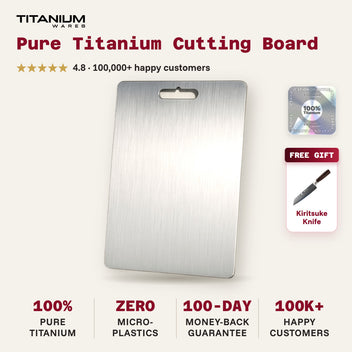
A pure titanium cutting board that never soaks up juices, stains or smells. Rinses clean or goes in the dis...
Titanium Cutting Board Marketing Claims vs. Reality: What's True and What's Hype
Let's examine the most common claims so you can separate genuine benefits from marketing exaggeration.
"100% Pure, Medical-Grade Titanium"
What’s true: A genuine titanium cutting board is typically made from commercially pure Grade 1 titanium, the same grade covered by ASTM F67 for medical use. It is valued for its corrosion resistance, lightweight strength, and biocompatibility, which makes it well suited to quality kitchenware.
What’s misleading: No titanium cutting board is literally 100% titanium. Even the purest commercial titanium contains trace elements such as iron, oxygen, and carbon, which remain from the refining process. The difference lies in how much: the higher the titanium percentage, the purer the board, and the higher the price usually is. That’s why two boards that look identical can be priced very differently. Always ask the seller for the exact titanium percentage. Be especially wary of very cheap listings. Some boards sold as “titanium” are actually stainless steel, or only have a thin titanium coating over another metal. Listings like these are a big reason shoppers ask, “are titanium cutting boards a scam?”
"Antibacterial and Never Harbors Bacteria"
What's true: Titanium's non-porous, moisture-resistant surface won't absorb food juices like wood or develop deep knife grooves like plastic. This makes it easy to clean and helps reduce the buildup of food residue, odors, and bacteria.
What's misleading: Be cautious of claims that titanium boards are self-disinfecting or kill all bacteria on their own. Titanium offers hygienic advantages, but proper cleaning after every use is still necessary.
"No Microplastics"
What's true: A solid, uncoated titanium cutting surface contains no plastic, so ordinary knife contact releases no plastic particles from the board itself. This is a clear material advantage for anyone looking to reduce plastic exposure in the kitchen.
That matters because plastic boards do shed. A 2023 study in Environmental Science & Technology found that chopping on polyethylene and polypropylene boards released microplastics, with amounts varying by board material and chopping conditions.
"Knife-Friendly"
What’s true: This is where glass loses the comparison outright. Glass is harder than hardened knife steel, so the edge deforms and chips rather than the board. Cooks who use a glass board daily often notice their knives going blunt within weeks.
Where titanium stands: Titanium works with your knives, not against them. It’s slightly firmer than wood or plastic, but it’s still softer than the hardened steel in your kitchen knives, so your blades stay in charge. In daily use you’ll barely notice a difference in sharpness. On the rare occasion an edge needs attention, it simply rolls instead of chipping, and a few quick strokes on a honing rod make it razor-ready again. Add the fact that titanium never splinters, cracks, or holds onto bacteria, and you get a board that’s easy on your knives and built to last a lifetime.
Curious about the details? See Are Titanium Cutting Boards Bad for Knives?
"Scratch-Proof and Indestructible"
What's true: Titanium is durable, corrosion-resistant, and moisture-resistant, so it won't warp, crack, or rot like wood can. Scratches on titanium also tend to be shallower than the deep grooves in wood or plastic, where food residue can collect.
What's misleading: No cutting board is scratch-proof. Titanium will show light surface marks with regular use, but these are cosmetic and do not affect performance or food safety when the board is properly cleaned. Overpromises like “scratch-proof” are exactly what lead people to wonder, “are titanium cutting boards a scam?”
How to Protect Your Knives on a Titanium Cutting Board
How your knives hold up on titanium depends on your knife type, cutting technique, and blade care. These habits keep edge wear to a minimum:
- Slice, don't hack. Use controlled slicing or rocking motions instead of forceful chopping, especially with thin, hard Japanese-style knives.
- Hone often, sharpen when needed. Honing realigns a rolled edge; sharpening restores a dull one. Check your edge a little more often if you use titanium daily.
- Skip bones and frozen foods. Forcefully chopping bones, frozen foods, or very hard ingredients stresses the knife edge on any hard surface.
- Use the right knife for heavy jobs. Save cleavers and sturdy chef's knives for tough tasks, and keep delicate blades for gentle slicing.
The Real Downsides of Titanium Cutting Boards That the Ads Don't Mention
Titanium has clear advantages, but it also has trade-offs worth knowing before you buy. An honest answer to “are titanium cutting boards a scam?” has to include them.
Noise and Cutting Feel
Titanium is a rigid metal, so chopping makes a light metallic sound and feels firmer than wood or rubber. Some cooks adjust within a few days; others never warm to it. If a quiet, cushioned cutting feel matters to you, this is a real drawback.
Price Compared to Other Boards
Titanium boards cost more than wood or plastic boards, and there’s a real reason for it. Titanium is expensive to produce: it takes an energy-intensive refining process to extract, and it’s notoriously difficult to cut, shape, and finish. High-purity boards cost even more, since every extra decimal point of purity requires more refining. But that higher price is an investment, not an expense.
A wood board needs regular oiling and can warp or crack, and a plastic board needs replacing once deep knife grooves set in. A solid titanium board can last for years without any of that. Over time, buying one board instead of replacing several often makes titanium the more economical choice.
Real vs. Fake Titanium Cutting Boards: How to Tell the Difference
Not every board marketed as titanium is made from solid titanium. Some use titanium-coated surfaces, mixed materials, or descriptions too vague to tell what you're buying. Here's how to evaluate a product before you purchase.
What a Trustworthy Product Page Should Include
A quality listing makes it easy to see what the board is made of. Look for a page that:
- States clearly whether the board is solid titanium or coated
- Names the titanium grade and material specifications
- Provides credible testing or manufacturer information
- Explains the board's construction and care instructions
- Avoids unrealistic claims such as "indestructible" or "self-sanitizing"
What Customer Reviews Can Reveal
Reviews show how a board performs in everyday use. Watch for repeated reports of:
- Surface peeling or flaking
- Unexpected rust or corrosion
- Material or construction that differs from the listing
Check the Titanium Grade and Material Certificates
Look for a stated grade, such as Grade 1 commercially pure titanium, backed by documentation such as material test reports, food-contact testing, or independent laboratory results. ASTM B265 is the standard that covers titanium sheet, strip, and plate, including commercially pure grades. The strongest evidence is documentation for the material used in the finished product.
Weigh the Board
Titanium has a density of about 4.5 g/cm³, compared with about 7.9–8.0 g/cm³ for stainless steel. A titanium board of the same size and thickness should feel noticeably lighter.
Examine the Surface
A brushed metal finish is common on titanium boards, but coated boards can look identical. Check the edges and corners, where a coating is most likely to chip or peel.
Don't Rely on the Magnet Test Alone
Titanium is non-magnetic, so a strong pull from a magnet suggests other metal is present. However, some stainless steels are also non-magnetic or only weakly magnetic.
Weight, surface, and magnet checks are useful first filters, but none of them proves what a board is made of. Clear specifications and credible testing remain the most reliable evidence.
Is a Titanium Cutting Board Worth It?
A titanium cutting board is worth it if its strengths match how you cook. Once you’ve settled “are titanium cutting boards a scam?”, the next question is whether one suits your kitchen. Here's how it compares with other common materials:
|
Feature |
Titanium |
Wood |
Plastic |
Stainless steel |
|---|---|---|---|---|
|
Surface |
Non-porous |
Porous |
Non-porous when new; grooves with use |
Non-porous |
|
Knife-edge wear |
Moderate |
Low |
Low |
High |
|
Upkeep |
Soap and water; no oiling |
Hand-wash and regular oiling |
Easy to wash; replace when deeply grooved |
Soap and water |
|
Plastic shedding |
None |
None |
Yes |
None |
|
Weight |
Light for a metal board |
Medium to heavy |
Light |
Heavy |
|
Typical price |
Higher |
Mid-range |
Low |
Mid-range |
A Titanium Board May Be Right for You If:
- You want a non-porous cutting surface that's easy to clean.
- You want to avoid plastic shedding from the cutting surface.
- You often prepare raw meat, fish, or strong-smelling ingredients.
- You prefer a lightweight, corrosion-resistant metal board.
- You don't mind light surface marks or a metallic cutting sound.
- You're comfortable honing and sharpening your knives.
You May Prefer Another Material If:
- You prefer a quiet, cushioned cutting feel.
- You want a budget-friendly cutting board.
Upgrade Your Kitchen with the Titanium Wares Pure Titanium Cutting Board
Now you know what separates a genuine titanium cutting board from the hype: a stated grade, solid construction, and test results you can verify. That’s exactly how we built ours.
The Titanium Wares 100% Pure Titanium Cutting Board is made from solid, commercially pure Grade 1 titanium, lab-verified at 99.96% purity and SGS-tested. There’s no plastic, no coating, and no other metal hiding underneath, just one solid sheet of titanium from edge to edge. What you see on our product page is exactly what arrives in your kitchen.
Every day, that shows up in ways you’ll notice. Raw chicken, fish, garlic, beets: nothing soaks in, nothing stains, and nothing lingers. There’s no oiling schedule, no warping after a wash, and no deep grooves building up over time. Rinse it, wipe it, and it’s ready for the next meal.

Not all titanium cutting boards are created equal. Look for solid titanium construction, clearly stated material grades, and credible testing to make a more informed purchase.
Key Features:
- 99.96% lab-verified titanium: solid commercially pure Grade 1 titanium, SGS-tested, with the numbers to back it up.
- No plastic, no coating: the cutting surface sheds no microplastics and has no coating that can chip, peel, or flake.
- Non-porous and hygienic: resists moisture, stains, and odors, so food residue has nowhere to hide.
- Zero maintenance: no oiling, no conditioning, and no replacing it every year. It cleans easily with soap and water or in the dishwasher.
- Built to last: won’t warp, crack, or rust, and holds up to years of daily use.
- Kind to your knives: softer than hardened knife steel and far gentler than glass, so your blades stay sharp with regular honing.
- Lightweight for a metal board: about 40% lighter than stainless steel of the same size, easy to lift, move, and store.
- Versatile: works for meat, fish, fruits, vegetables, bread, and everything in between.
- Three sizes: pick the one that fits your counter and your cooking.
Try It Risk-Free for 100 Days
We’re confident you’ll love cooking on titanium, but you don’t have to take our word for it. Every board comes with a 100-day money-back guarantee, so you can put it through real meals in your own kitchen. If it doesn’t earn its place on your counter, send it back.
Conclusion
So, are titanium cutting boards a scam? No. Genuine solid titanium boards deliver real benefits: a durable, non-porous, plastic-free surface that's easy to keep clean. The disappointments come from vague listings, coated boards sold as solid titanium, and claims like "self-disinfecting" or "indestructible."
Check the grade, the construction, and the test reports before you buy, and weigh the trade-offs of noise, price, and knife wear against your cooking habits. If a hygienic, low-maintenance board fits your kitchen, visit Titanium Wares to explore the Pure Titanium Cutting Board and find the size that suits you.
For more helpful kitchen tips, follow us on Facebook and Instagram! If you have any questions about Titanium Wares products or promotions, contact us anytime at support@titaniumwares.com. Our 24/7 team is always happy to help.
Frequently Asked Questions
Are Titanium Cutting Boards on Amazon a Scam?
Not all of them. Some listings, however, use misleading material claims or sell coated boards as solid titanium. Check the titanium grade, construction details, customer reviews, and return policy before buying.
Do Titanium Cutting Boards Dull Knives?
They can, to some extent. Titanium is harder than wood or plastic, so edges wear a little faster than on those boards. Slicing instead of hacking and honing regularly keep blades in good shape.
Is Titanium Better Than Stainless Steel for Cutting Boards?
For most home cooks, yes. Titanium is about 40% lighter than stainless steel of the same size, is highly corrosion-resistant, and is gentler on knife edges. Stainless steel boards usually cost less.
Are Titanium Cutting Boards Toxic?
No. Genuine food-grade titanium is generally considered safe for food preparation. Choose an uncoated board with clear material specifications, such as Titanium Wares' SGS-tested Grade 1 titanium board.
Can You Put a Titanium Cutting Board in the Dishwasher?
Yes. Titanium Wares' cutting board is dishwasher-safe thanks to titanium's corrosion resistance. Hand-washing with dish soap and water is still recommended to keep the surface looking its best for longer.
How Long Does a Titanium Cutting Board Last?
With proper care, a solid titanium board can last for many years. It won't warp, crack, or rust like wood or steel can, and it doesn't need replacing when it gets grooved like plastic.

