 Cutting Board
 Frying Pan Pro
 Double-Sided Board


You wash your cutting board every day, but have you ever checked what it’s actually made of? Plastic particles, glue resins, and worn coatings can end up right where you prepare food. The best non-toxic cutting board uses a simple, food-safe material with no hidden layers and a surface that’s easy to clean. In this guide, Titanium Wares explains what makes a board truly non-toxic, compares the top materials, and shows why pure titanium belongs on your shortlist.
In this article
Key Takeaways
- A non-toxic cutting board depends on its material, binders, coatings, and how easily it cleans.
- Plastic-free surfaces help cut down on microplastics in everyday food prep.
- Non-porous materials like pure titanium don't absorb juices or odors and rinse clean quickly.
- Look for a stated material grade and independent food-contact testing, not just a "non-toxic" label.
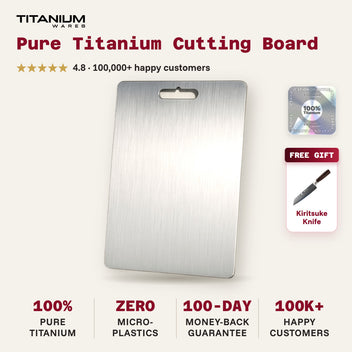
- The Titanium Wares 100% Pure Titanium Cutting Board is plastic-free, coating-free, and dishwasher-safe.
What Makes a Cutting Board Non-Toxic?
A non-toxic cutting board isn't defined by its main material alone. What holds it together, what covers it, and how well it stays clean all matter just as much.
Microplastics
Microplastics are plastic fragments smaller than 5 mm. Every knife stroke on a plastic board leaves a groove, and those grooves can shed tiny particles into your food.
A 2023 study led by researchers at North Dakota State University, published in Environmental Science & Technology, measured this directly. It estimated that a person could be exposed to 14.5 to 71.9 million polyethylene microplastics a year from chopping boards, and about 79.4 million from polypropylene boards (ACS).
Scientists are still studying the long-term health effects. Even so, many home cooks now prefer a plastic-free surface for something they use every single day.

Plastic cutting boards can develop deep knife grooves over time, while pure titanium offers a non-porous, plastic-free cutting surface.
Glues, Resins and Formaldehyde
Not every board is one solid piece. Bamboo boards are strips pressed and glued together, and composite or plant-fiber boards rely on resins to bind their fibers.
Some adhesives are formaldehyde-based. Formaldehyde is classified as a known human carcinogen, which is why shoppers want to know which binders were used.
Reputable makers use food-safe adhesives and say so clearly. Look for a full material breakdown and food-contact compliance information, not just an "eco-friendly" label.
Finishes and Coatings
A finish protects the surface. On wood, it's usually food-grade mineral oil or beeswax that soaks into the grain and needs reapplying.
A coating is different. It's a separate layer, such as a polymer or non-stick film, bonded on top of a base material. Since knives make direct contact with it, you'll want to know exactly what it's made of.
Two questions cut through the marketing: Is there a coating at all? And if so, is it rated for food contact? The product's specifications should answer both.
Porosity and Bacteria
Porosity is how much liquid a material can absorb. Porous surfaces can take in moisture, raw meat juices, and strong odors like garlic or fish.
Deep knife grooves and worn spots make this harder to manage. They give residue more places to settle and make scrubbing less effective.
That said, no material replaces good habits. Every cutting board needs prompt washing and thorough drying.
A pure titanium cutting board that never soaks up juices, stains or smells. Rinses clean or goes in the dis...
The Safest Non-Toxic Cutting Board Materials
The safest cutting board materials share a few traits: a clearly identified composition, no questionable binders or coatings, and a surface you can keep clean. Here's how the leading options compare.
Pure Titanium
Titanium is a highly corrosion-resistant metal, trusted in fields like aerospace and medical implants where stability matters. Grade 1 is commercially pure titanium, the purest of the standard commercial grades, with no alloying metals blended in.
That purity is what makes it so well suited to direct food contact:
-
Non-reactive: Acidic foods like lemon, tomato, and vinegar don't react with the surface.
-
Non-porous: Juices, liquids, and odors stay on top and rinse away instead of soaking in.
-
Nothing added on top: With no plastic and no coating, there's no layer that can peel, flake, or wear off.
-
Corrosion-resistant: Titanium forms a natural protective oxide layer, so it resists rust with daily washing.
One detail matters more than any other here: whether the board is solid pure titanium. Some products use "titanium" in the name but are titanium-coated steel or mixed alloys. Look for a stated grade and independent testing.
This is where the Titanium Wares Pure Titanium Cutting Board earns its place. It's made from 100% Grade 1 titanium, SGS-tested, with no applied coating. In daily use, it washes clean with warm soapy water or in the dishwasher, and it never needs oiling. (For a deeper look, see are titanium cutting boards safe.)
Best for: Cooks who want one plastic-free, low-maintenance board for everything from raw chicken to fresh fruit.
Solid Hardwood With a Food-Safe Finish
Dense hardwoods like maple, walnut, and cherry have been kitchen staples for generations. Their tight grain holds up well to daily chopping, and they're gentle on knife edges.
Their safety depends on the finish. Food-grade mineral oil or a beeswax blend protects the wood, and it needs reapplying regularly. Wash by hand and dry the board upright to keep it in good shape.
Best for: People who love natural materials, a soft cutting feel, and a traditional look. However, if regular oiling feels like a hassle, consider a non-porous, low-maintenance surface like titanium.
Stainless Steel
Stainless steel is a fixture in commercial kitchens and food processing. It's corrosion-resistant, non-porous, and easy to wipe clean.
Grades and compositions vary, so check which one you're buying. 304 stainless (often labeled 18/8) is a common food-grade choice.
Stainless steel is a practical, non-porous option, especially for budget-conscious shoppers. Pure titanium offers a lower material weight at the same dimensions and excellent corrosion resistance, making it worth considering for those who frequently lift, wash, or move their cutting board.
Best for: Cooks who want a non-porous metal surface in a familiar, widely available material.
Natural Rubber
Natural rubber comes from latex harvested from rubber trees. Its slightly yielding surface grips the counter and is kind to knife edges, which is why many professional kitchens and sushi chefs use it.
Many "rubber" boards are actually synthetic, so confirm the material. Look for food-contact certification such as NSF, and expect to wash it by hand.
Best for: Cooks who prioritize knife comfort and a non-slip grip.
Wheat Straw and Plant-Fiber Boards
These boards are made from agricultural fibers, such as wheat straw, rice husk, or wood pulp, bound together with a resin. They're lightweight, affordable, and often dishwasher-safe.
Because the binder matters, check what holds the fibers together. A good product clearly states it's formaldehyde-free and tested for food contact.
Best for: Budget-conscious shoppers who want a light, easy-care board with clearly disclosed materials.
Which One Is The Best Material For Cutting Board?
The best cutting board material for health depends on what you value most. Use this quick guide to match a material to your priorities.
|
Your priority |
Best-fit materials |
|
A non-porous surface |
Pure titanium, stainless steel |
|
Less contact with plastic |
Pure titanium, hardwood |
|
Natural materials |
Hardwood, natural rubber |
|
Easy cleaning and low maintenance |
Pure titanium, stainless steel |
|
A knife-friendly cutting feel |
Hardwood, natural rubber |
If you're looking for a board with no plastic and no coating, one that won't absorb liquids or food odors, cleans up easily, and never needs oiling, pure titanium is a choice well worth considering. The Grade 1 titanium cutting board from Titanium Wares is built around exactly those needs.
4 Best Non-Toxic Cutting Boards of 2026
A truly non-toxic cutting board does more than avoid harmful chemicals on day one. It stays safe after years of chopping, washing, and drying. That is why we judged each board on four things: how openly the brand discloses its materials, whether the surface relies on a coating or finish that can wear away, how easily the board comes clean after raw meat, and how much upkeep it needs over time. Each pick below is a different material, so you can choose by what matters most in your kitchen. If you want one board that does well on all four, our top pick is the clear winner.
1. Titanium Wares 100% Pure Titanium Cutting Board: Best Overall for Low Maintenance
Titanium Wares offers a safer, more convenient food preparation solution with cutting boards made from solid Grade 1 titanium, free from plastic and applied coatings. Unlike conventional boards, their non-porous surface is easy to clean, requires no oiling, and is dishwasher-safe. Available in three sizes – Small, Medium, and Large – the boards suit a wide range of kitchen tasks, from preparing vegetables to cutting meat and fish. Titanium Wares focuses on practical kitchenware that combines quality, functionality, and long-lasting durability.
-
Material: SGS-tested Grade 1 titanium, no applied coating, no plastic
-
Testing: Independently SGS-tested for food contact
-
Made without: PFAS, PTFE, PFOA, lead, cadmium, plastic, or coatings
-
Sizes: Small, Medium, and Large, or a 3-piece set
-
Care: Soap and water or the dishwasher; no oiling
-
Guarantee: Free shipping and a 100-day money-back guarantee
Best for: Busy home cooks, families who prep a lot of raw meat and fish, and anyone who wants a cutting board they can wash, dry, and never think about again.
Pros
- Solid pure titanium with no coating to chip or wear off
- Independently SGS-tested for food contact
- Non-porous surface that doesn’t absorb odors, stains, or juices
- Dishwasher-safe with no oiling or seasoning required
- Won’t crack, warp, or split like wood and bamboo
- Available in three sizes or as a set for separating raw meat and produce
- Risk-free to try with free shipping and a 100-day money-back guarantee
Cons
- Firmer under the knife than wood or rubber, so blades may need honing a little more often
- Higher upfront cost than plastic or bamboo, though it lasts far longer
2. John Boos Maple Cutting Board: Best Hardwood Board
John Boos has made butcher blocks in the USA since 1887, and its solid hard maple boards remain the benchmark for classic hardwood. Each board is cut from dense North American maple and finished with food-grade mineral oil. It suits cooks who enjoy the warmth of wood and see board care as part of the cooking ritual.
- Material: Solid hard maple
- Finish: Food-grade mineral oil
- Care: Hand wash, dry upright, and re-oil regularly
Best for: Cooks who love the look and feel of wood and don’t mind a regular oiling routine.
Pros
- Tight-grain surface that is kind to knife edges
- Made in the USA by a long-standing brand
- Attractive enough to use as a serving board
Cons
- Not dishwasher-safe
- Needs regular oiling to prevent drying, cracking, and warping
- Porous surface can absorb odors and stains over time
3. NoTrax Sani-Tuff Natural Rubber Cutting Board: Best for Knife Comfort
Sani-Tuff boards are a common sight in professional kitchens and sushi counters. They are made from NSF-approved natural rubber, which gives slightly under the blade instead of resisting it. Chefs who work with fine Japanese or carbon-steel knives often choose rubber for exactly that feel.
- Material: Natural rubber, NSF-approved
- Care: Hand wash; the surface can be resurfaced over time
Best for: Owners of high-end knives who care most about protecting the edge.
Pros
- Soft, forgiving surface that helps knives stay sharp
- Heavy and grippy, so it stays put on the counter
- Can be sanded smooth again instead of replaced
Cons
- Heavy and awkward to lift and clean at home
- Hand wash only
- Light-colored surfaces can stain
4. Epicurean Wood-Fiber Cutting Board: Best Lightweight Option
Epicurean boards are made from compressed wood fiber bound with resin and pressed into a thin, rigid sheet. The brand is open about its materials and certifications, which is more than many budget boards offer. It is a common choice for small kitchens and renters who want something lighter than wood.
- Material: Wood-fiber composite, NSF-certified
- Care: Dishwasher-safe
Best for: Small kitchens and anyone who wants a light, easy-to-store board.
Pros
- Thin, light, and easy to store
- Dishwasher-safe
- Brand discloses its certifications
Cons
- Composite made with a resin binder, not a single pure material
- Hard surface can show knife marks with heavy use
How to Choose a Non-Toxic Cutting Board
A few minutes of checking before you buy tells you far more than any "non-toxic" label. Run each board through these five questions.
-
Check the material: Is it a single pure material or a composite? "Titanium" or "bamboo" on the label doesn't tell you the full makeup.
-
Look for food-contact safety information: Reputable brands share certifications or independent test results, not just claims.
-
Understand the surface construction: Is there a coating, glue, or plastic layer where your knife meets the board?
-
Consider porosity and cleaning: Does the surface absorb liquids and odors? Can you clean it thoroughly with soap and water?
-
Review maintenance requirements: Will it need regular oiling, resurfacing, or frequent replacement?
Run the Titanium Wares board through that list and the answers are easy to find. The material is stated plainly as Grade 1 titanium, with SGS testing behind it. The cutting surface has no coating and no plastic, and it needs no oiling. Clear care instructions and a 100-day money-back guarantee round it out.
How to Keep Your Cutting Board Safe Over Time
Even the safest cutting board stays that way only with good habits.
-
Clean after each use: Wash with hot, soapy water right after prep, especially after raw meat, poultry, or fish.
-
Prevent cross-contamination: Use separate boards for raw proteins and ready-to-eat foods, or wash thoroughly between tasks.
-
Dry properly: Let the board dry completely, ideally standing upright, before you store it.
-
Inspect the surface: Check regularly for deep grooves, cracks, or warping that make cleaning harder.
-
Follow material-specific care: Oil wood, hand-wash rubber, and follow the maker's instructions for everything else. (For titanium, see how to clean a titanium cutting board.)

Pure titanium cutting boards are easy to maintain. Wash thoroughly with warm, soapy water after use and dry completely before storing.
Conclusion
There's no single perfect cutting board for everyone. The healthiest choice comes down to three things: what the board is made of, what sits on its surface, and how easily you can keep it clean.
If a non-porous, plastic-free, low-maintenance surface is what you're after, pure titanium is well worth considering. Take a closer look at Titanium Wares' pure titanium cutting board and see if it fits your kitchen.
For more helpful kitchen tips, follow us on Facebook and Instagram! If you have any questions about Titanium Wares products or promotions, contact us anytime at support@titaniumwares.com. Our 24/7 team is always happy to help.
FAQs
What is the safest cutting board material?
The safest materials have a clearly disclosed composition, no questionable coatings or binders, and a surface that's easy to clean. Pure titanium, solid hardwood with a food-safe finish, stainless steel, and natural rubber all fit when made well.
Are bamboo cutting boards non-toxic?
They can be. Bamboo boards are strips glued together, so their safety depends on the adhesive. Choose brands that confirm formaldehyde-free, food-safe glue.
Can I cut raw meat and vegetables on the same board?
It's safest to use separate boards for raw proteins and ready-to-eat foods. If you use one board, wash it thoroughly with hot, soapy water between tasks.
Do non-toxic cutting boards need special cleaning?
Most just need hot, soapy water and thorough drying. Wood also needs regular oiling, while pure titanium needs no oiling and is dishwasher-safe.
Where can you buy an authentic titanium cutting board?
Choose a board that clearly states it is solid titanium, not titanium-coated. One option is the Titanium Wares 100% Pure Titanium Cutting Board, made from SGS-tested, commercially pure Grade 1 titanium with no plastic or applied coating on the cutting surface. Available in three sizes, it has a non-porous surface that resists moisture, stains, and odors, needs no oiling, and can be washed with soap and water or in the dishwasher. A 100-day money-back guarantee lets you try it in your own kitchen first.

