 Cutting Board
 Frying Pan Pro
 Double-Sided Board


Titanium has moved from aerospace labs into home kitchens, and cutting boards are now one of its most popular uses. But the labels can be confusing: “pure titanium,” “titanium alloy,” “titanium-coated,” and “titanium steel” don’t mean the same thing. So how do you know the board you’re buying is really 100% pure titanium? In this guide, Titanium Wares breaks down the main material types, simple checks you can do at home, and the documents worth asking for before you buy.
In this article
Key Takeaways
-
A solid titanium cutting board is different from one made with a titanium-containing coating or another metal.
-
Commercially pure titanium includes Grades 1–4, while Grade 5 is a titanium alloy.
-
Magnet, weight, and visual checks can reveal warning signs, but none can confirm titanium purity on their own.
-
Material composition reports and food-contact test results help buyers verify what a cutting board is made of and whether it has been evaluated for food use.
What Does "100% Pure Titanium" Actually Mean?
In the titanium industry, "pure" has a specific meaning. Commercially pure (CP) titanium is unalloyed titanium with small, tightly controlled amounts of elements such as oxygen, iron, carbon, nitrogen, and hydrogen. Standards like ASTM set exact limits for each grade.
Titanium alloys are different. Other metals are added on purpose to change strength and other properties.
The three grades you'll see most often:
-
Grade 1: Commercially pure titanium with the lowest allowed impurity levels. It's the softest, most ductile grade, with excellent corrosion resistance.
-
Grade 2: Also commercially pure. Slightly higher oxygen and iron limits make it stronger than Grade 1, and it keeps excellent corrosion resistance.
-
Grade 5 (Ti-6Al-4V): An alloy of titanium with about 6% aluminum and 4% vanadium.
So "100% pure titanium" on a product page should be read as commercially pure titanium of a stated grade.
Grade 1 and Grade 2 are the most common commercially pure grades. That's why a Grade 1 board, like the one Titanium Wares makes, belongs in the pure titanium category.
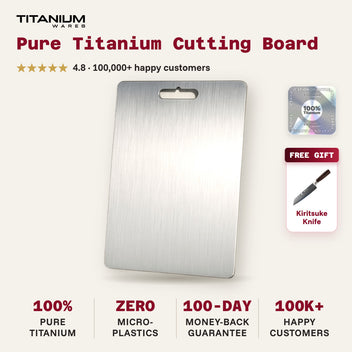
A pure titanium cutting board that never soaks up juices, stains or smells. Rinses clean or goes in the dis...
Pure Titanium vs Titanium Alloy vs Titanium-Coated Steel
Commercially Pure Titanium (Grade 1 and 2)
Grade 1 and Grade 2 are the two most widely used commercially pure grades. Both form a thin, stable oxide layer that protects the metal from rust and corrosion. Both are solid metal all the way through, so the surface is non-porous. Food liquids and odors stay on top instead of soaking in. With the right product testing, both are suitable for food-contact use.
The main difference is mechanical. Grade 1 is softer and more formable, which makes it easy to shape and finish smoothly. Grade 2 is a little stronger and is the most common grade in industrial applications.
Titanium Wares uses Grade 1 titanium for its boards. If you want a cutting board made of pure titanium, Grade 1 or Grade 2 is what you should see on the spec sheet.
Titanium Alloy (Grade 5 / Ti-6Al-4V)
Grade 5, also called Ti-6Al-4V, combines titanium with about 6% aluminum and 4% vanadium. It's valued for its high strength and excellent strength-to-weight ratio, which is why it's common in aerospace, engineering, and industrial parts.
Grade 5 is a high-quality titanium material. It simply isn't commercially pure titanium, so it shouldn't be sold under a "pure titanium" label.
Titanium-Coated and "Titanium Steel" Boards
A titanium-coated board starts with a steel base. A thin surface layer containing titanium, often a titanium compound applied through a coating process, sits on top. Underneath, it's still steel, not a solid sheet of titanium.
"Titanium steel" is a loose trade term. It doesn't tell you the actual composition. When you see it, ask the seller exactly what the board is made of, layer by layer. A few questions upfront help you avoid paying titanium prices for a different material.
Comparison Table
|
Criteria |
Pure Titanium |
Titanium Alloy |
Titanium-Coated Steel |
|
Composition |
Commercially pure titanium |
Titanium plus alloying elements |
Steel base with a surface coating |
|
Common grades |
Grade 1, Grade 2 |
Grade 5 |
Depends on construction |
|
Commercially pure titanium? |
Yes, by grade standard |
No |
No |
|
Construction |
Solid titanium |
Solid titanium alloy |
Multiple material layers |
|
Corrosion resistance |
Excellent |
Excellent |
Depends on coating and steel base |
|
Right fit if you want pure titanium? |
Yes |
Different material category |
No |
The key distinction is simple. A product that contains titanium is not the same as a product made of pure titanium. Check which one you're actually buying.
"Medical Grade" and "Hospital Grade": Marketing vs Reality

Medical grade vs. hospital grade: What do these labels really mean?
"Medical grade" and "hospital grade" sound reassuring. That's exactly why they appear in kitchenware ads. But neither phrase is a titanium grade.
Titanium is classified by defined grades and standards, such as Grade 1, Grade 2, and Grade 5. Medical specifications exist too. For example, ASTM F67 covers unalloyed titanium for surgical implants, while ASTM F136 covers a Ti-6Al-4V alloy. So "medical grade titanium" can point to several different materials. On its own, it doesn't tell you which one you're getting.
There's a second issue. A material used in medical devices doesn't automatically prove that a cutting board made from it has passed food-contact safety testing. Those are separate questions with separate tests.
When you see these labels, look past them. Ask for the exact grade, the chemical composition, the standard the material meets, and real test results. Those details tell you far more than any marketing phrase.
How to Tell If Your Titanium Cutting Board Is Real
The Magnet Test
Pure titanium isn't ferromagnetic, so a magnet won't grab it the way it grabs iron or many steels. If a magnet sticks firmly, the board likely contains an iron-based metal.
The catch: many stainless steels, such as common 304, are barely magnetic too. A magnet that doesn't stick doesn't prove much. Treat this as a quick screen, not proof.
The Weight Test
Titanium has a density of about 4.51 g/cm³, roughly 40% lighter than common stainless steel. Compare boards of the same size and thickness, and a titanium board should feel noticeably lighter.
Still, thickness, design, and construction all affect weight. A lighter board isn't automatically titanium.
Check the Surface and Edges for Coating
Look closely at the surface and the edges. Signs worth noting include peeling, a layer with a slightly different color, or a visible difference between the face and the cut edges.
Coated boards are built differently from solid titanium, and the edges are often where that shows. A solid titanium board should look consistent throughout.
That said, your eyes can't read chemical composition. Visual checks help you spot red flags, but they can't confirm the grade.
A Mill Test or SGS Report
Home checks can reveal possible warning signs, but they cannot confirm a board's exact titanium grade or composition.
For stronger verification, ask the seller for a Mill Test Certificate (MTC) or an independent laboratory report. Check that the documentation identifies the tested material and can be linked to the product or production batch.
The certifications section below explains how to evaluate these reports and what each type of testing actually confirms.
Price Red Flags
Titanium costs more to source and machine than wood, plastic, or steel. A price far below similar boards of the same size, thickness, and stated quality is a sign to dig deeper.
Low price alone doesn't prove a board is fake, though. Check the specs, the origin, and the material report before you decide.
Which Certifications Should a Titanium Cutting Board Have?
No single certificate tells the whole story. These are the documents worth looking for:
-
Material grade certification: Confirms the titanium grade and its chemical composition.
-
SGS testing report: An independent report from SGS. It can verify material composition when the test scope covers it.
-
Food contact safety testing: Tests how the material performs in contact with food, based on the rules of the market where it's sold.
-
Manufacturer documentation: Clear information on the product's origin, material, and construction.
Two references are useful here. ASTM B265 is the standard specification for titanium and titanium alloy strip, sheet, and plate, which is the form used to make flat boards. Food contact rules vary by market, such as FDA requirements in the United States or Regulation (EC) No 1935/2004 in the European Union.
Titanium Wares is a practical example of material transparency. Its product page lists SGS-tested Grade 1 titanium, food-contact testing, and a surface made without PFAS, PTFE, PFOA, lead, cadmium, plastic, or coatings. For more on safety, see our guide on whether titanium cutting boards are safe.
Why Titanium Purity Matters When Choosing a Cutting Board
When buying a titanium cutting board, knowing the material grade helps you understand what you're paying for.
A solid commercially pure titanium board offers a consistent metal surface throughout, rather than relying on a titanium-containing coating. That distinction matters when comparing products with similar appearances but different constructions.
Commercially pure titanium also offers excellent corrosion resistance and a non-porous surface that doesn't absorb food liquids or odors. These qualities can make everyday cleaning and maintenance straightforward, although proper washing and food-handling practices are still essential.
However, higher titanium purity doesn't automatically mean a cutting board is safer or better than every titanium alloy. Material composition, surface finish, construction, and appropriate food-contact testing all matter.
The goal isn't simply to find the highest purity percentage. It's to choose a cutting board with clearly identified materials and trustworthy supporting documentation.

The Bottom Line
Is your titanium cutting board real? Start with the label, then look for the grade. Grade 1 or Grade 2 means commercially pure titanium. Grade 5 means a titanium alloy. "Coated" or "titanium steel" means a steel base. Quick home checks can raise questions, but a clear material report is what answers them.
For a verified pure titanium surface, the Grade 1 titanium cutting board is a simple place to start. If you prep raw meat and fresh produce side by side, the Double-Sided Titanium Cutting Board adds a second surface. One side is uncoated Grade 1 titanium (99.96% pure) for raw meat, poultry, and seafood. The other is wheat-straw fiber for fruit, vegetables, and bread. It also has a juice groove and non-slip feet, and it's dishwasher-safe.
Both come with free shipping and a 100-day money-back guarantee. For more helpful kitchen tips, follow us on Facebook and Instagram! If you have any questions about Titanium Wares products or promotions, contact us anytime at support@titaniumwares.com. Our 24/7 team is always happy to help.
FAQs
Is a titanium-coated cutting board the same as a pure titanium cutting board?
No. A titanium-coated board has a steel base with a thin titanium-containing layer on top. A pure titanium cutting board is made of solid commercially pure titanium, such as Grade 1, all the way through.
Is Grade 1 or Grade 2 titanium better for a cutting board?
Both are commercially pure titanium with excellent corrosion resistance. Grade 1 is softer and more formable, while Grade 2 is slightly stronger. Either is a solid sign that you're buying pure titanium rather than an alloy or a coated product.
Does a magnet test prove a titanium cutting board is real?
No. Titanium isn't magnetic, but many stainless steels aren't strongly magnetic either. Use the magnet as a quick screen, then confirm with a mill test certificate or SGS report.
What should an SGS report for a titanium cutting board show?
Look for the titanium grade, the element-by-element chemical composition, a report or sample number, and the testing body's name. Also check the scope, since a composition test and a food-contact safety test are different reports.
Is "medical grade titanium" better for a cutting board?
Not necessarily. "Medical grade" can refer to several different materials, and medical use doesn't prove food-contact safety. The exact grade, composition, and test results matter more than the label.

