 Cutting Board
 Frying Pan Pro
 Double-Sided Board


Titanium vs copper cutting board is a comparison between a working surface and a display piece. Copper looks beautiful, but it reacts with acidic food, tarnishes within days and needs regular polishing. Titanium does none of that. For real daily prep, a Titanium Wares titanium cutting board is the one you can actually cut on without thinking.
In this article
Key Takeaways
- Titanium is inert and low maintenance, making it a better everyday cutting surface than copper.
- Titanium stays unchanged through acidic foods like lemon, vinegar, and tomato.
- Unlike copper, titanium never tarnishes and needs no polishing.
- Most copper boards are designed for serving and charcuterie rather than daily cutting.
- The Titanium Wares 100% Pure Titanium Cutting Board handles raw meat, fruit, and acidic ingredients with zero upkeep.
What Is a Titanium Cutting Board?

A titanium cutting board is one sheet of Grade 1 titanium. The moment the metal meets air it forms a thin oxide layer that seals it. Nothing gets past that layer, which is why titanium is used inside the human body for implants.
Set against copper the contrast is sharp. Copper is a chemically busy metal that wants to react with its surroundings. Titanium is a chemically quiet one that does not.
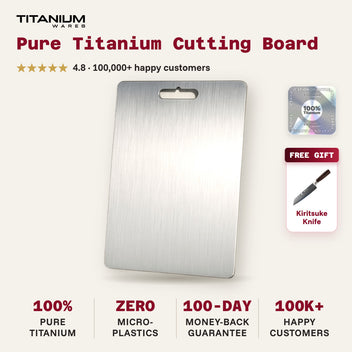
A pure titanium cutting board that never soaks up juices, stains or smells. Rinses clean or goes in the dis...
What Is a Copper Cutting Board?
A copper cutting board is a sheet of copper, sometimes lined and sometimes left bare. Copper is prized in kitchens for cookware because it conducts heat better than almost anything else. On a board, that property does nothing useful.

What copper does bring is appearance. It looks warm and expensive, which is why most copper boards on sale are marketed for serving cheese and charcuterie rather than for chopping onions.
Pros and Cons of Titanium Cutting Boards
In a titanium vs copper cutting board comparison, titanium is the practical surface and copper is the decorative one. Here is what titanium gives you day to day.
Pros
- Chemically inert, so acidic food changes nothing
- Never tarnishes and never needs polishing
- Non-porous and bacteria resistant for raw protein
- Dishwasher safe with no special care
- Lasts decades without maintenance
Cons
- Costs more than most everyday board materials
- Firmer under the blade than wood
- Shows cosmetic knife marks over time
- Does not have the warm look some kitchens want
Pros and Cons of Copper Cutting Boards
Copper is a genuinely impressive metal in the right place. A titanium vs copper cutting board comparison is mostly about whether a cutting board is that place.
Pros
- Striking appearance that suits a display kitchen
- Bare, clean copper resists bacterial growth
- Excellent heat conductor, so it stays cool to the touch
- Fully recyclable
- Doubles well as a serving or charcuterie board
Cons
- Reacts with acidic food such as citrus, vinegar and tomato
- Tarnishes quickly and needs regular polishing
- Soft enough that knives gouge the surface
- Polishes and lacquers used on it are not meant for knife contact
- Expensive for a surface most people never cut on
Titanium vs Copper Cutting Board: Key Differences
Both are metals and both look premium on a counter. Everything else in the titanium vs copper cutting board comparison comes down to how each metal behaves once food touches it.
| FACTOR | TITANIUM | COPPER |
|---|---|---|
| Construction | Single sheet of Grade 1 titanium | Sheet copper, often lacquered |
| Reacts with acid | No | Yes, strongly |
| Tarnishing | Never | Within days |
| Hardness | Marks under a knife | Gouges under a knife |
| Upkeep | Rinse and dry | Polishing, sometimes re-lacquering |
| Typical real use | Daily cutting | Serving and display |
| Upfront price | Premium | Premium |
Material and Construction
Titanium is pressed into one flat sheet with nothing added. There is no lacquer, no lining and no coating to wear through.
Copper boards are often lacquered to slow tarnishing. That lacquer is a coating, and a knife goes through coatings. Once it is breached you have bare copper meeting food on one side and a flaking finish on the other.
Durability and Lifespan
Copper is soft. Knives do not slide across it, they sink into it, and a copper board picks up deep gouges fast. Those gouges are not cosmetic the way marks on titanium are, because they expose fresh reactive metal.
Titanium does not warp, crack, corrode or tarnish, and the marks stay shallow. Decades later the board is still flat and still food-safe. Real numbers are in How Long Does a Titanium Cutting Board Last?
Hygiene and Food Safety

Copper has a real advantage here that is worth being fair about. Bare copper surfaces are naturally hostile to bacterial growth, which is why copper is used for door handles in some hospitals. On that one measure the titanium vs copper cutting board result is close.
The problem is that this only holds for clean, bare, un-lacquered copper. Add a lacquer and you lose the effect. Add knife gouges and you gain places for residue to sit. Add acidic food and the metal starts reacting with what you are eating.
Titanium takes a simpler route. It is non-porous with no grain and no grooves, so it stays a bacteria resistant surface for raw meat without any chemistry happening at all. More in Are Titanium Cutting Boards Safe?
Knife Friendliness
Copper is softer than titanium, so in theory it is gentler on an edge. In practice the softness is the problem. The blade digs in, the surface deforms around it, and you end up fighting a rutted board.
Titanium is firmer and stays smooth. Edges dull a little faster than on wood but the knife keeps gliding. Detail in Do Titanium Cutting Boards Dull Knives?
Weight and Portability
Copper is dense, noticeably heavier than titanium for the same size board. A large copper slab is a two-handed lift and awkward at a wet sink.
Titanium is roughly 43 percent lighter than steel by volume and lighter again than copper. In the large size it is still comfortable to carry one-handed.
Price Comparison
Copper is not cheap. Decent copper boards sit in the same price band as titanium, sometimes above it.
That makes the titanium vs copper cutting board decision unusual, because price is not the deciding factor. You are paying a similar amount for two very different levels of practicality.
Environmental Impact
Copper recycles extremely well and holds scrap value, which is a genuine point in its favour.
Titanium also recycles, and it has the advantage of rarely needing to. A board that works for thirty years is thirty years of nothing being replaced.
Titanium vs Copper Cutting Board: Which One Is Better?
Titanium wins the titanium vs copper cutting board comparison for anyone who actually cuts on their board. Copper reacts with acid, tarnishes constantly and gouges under a knife.
Copper wins if the board is going on a table rather than under a knife. For cheese, charcuterie and photographs it is hard to beat.
If you are weighing other metal options, the closest real comparison is covered in Titanium vs Stainless Steel Cutting Boards
Where to Buy The Best Quality Titanium Cutting Board?

Plenty of listings use the word titanium. Fewer tell you the grade. Every Titanium Wares Titanium Cutting Board is made from Grade 1 food-safe titanium, with no coating, no resin and no filler. Each one is SGS-tested, so the material claim arrives with paperwork behind it.
Small, medium and large cover most kitchens. There is no lacquer to breach, no tarnish to polish and nothing that reacts with citrus. Rinse it, dry it, put it away.
Still comparing brands? Our roundup of the Best Titanium Cutting Board for 2026 shows what separates solid titanium from a lookalike.
Conclusion
The titanium vs copper cutting board answer depends on what the board is for. As a surface you cut on daily, titanium wins without argument. It stays inert through citrus and vinegar, never tarnishes, needs no polishing and keeps working for decades.
Copper earns its place on the table rather than under the knife. If you want one board that handles raw meat, acidic fruit and everything else without reacting or needing upkeep, a Titanium Wares titanium cutting board is the one to buy.
For more helpful kitchen tips, follow us on Facebook and Instagram! If you have any questions about Titanium Wares products or promotions, contact us anytime at support@titaniumwares.com. Our 24/7 team is always happy to help.
Frequently Asked Questions
Can you cut food directly on copper?
You can, but it is not a good idea for anything acidic. In a titanium vs copper cutting board comparison this is the main separator, because copper reacts with citrus, vinegar and tomato while titanium does not. Most copper boards are sold for serving rather than cutting.
Does copper resist bacteria?
Bare, clean copper does, which is why it turns up on hospital door handles. The effect depends on the copper being unlacquered and reasonably clean, and it does nothing about the reactivity problem with acidic food.
Does a copper cutting board need polishing?
Yes. Copper tarnishes quickly in a kitchen, often within days. Keeping it looking right means regular polishing, and polishes are not something you want near a surface you cut food on.
Which lasts longer, titanium or copper?
Titanium. Copper is soft, so knives gouge it, and the surface keeps changing through tarnish and reaction. A titanium board stays flat and chemically unchanged for ten to thirty years or more.
Is titanium worth it over copper?
For cutting, yes, and the prices are often similar. The titanium vs copper cutting board choice is not really about cost, it is about whether you want a surface that works or one that looks good on a table.

