 Cutting Board
 Frying Pan Pro
 Double-Sided Board


Titanium vs plastic cutting board comes down to one thing most people never think about, which is what ends up in your food. Plastic sheds plastic particles as it wears down. Titanium does not. For everyday cooking, a Titanium Wares titanium cutting board is the better surface on hygiene, lifespan and food safety. Plastic only wins on price.
In this article
Key Takeaways
- Titanium leads on hygiene, lifespan, and food safety compared with plastic.
- Plastic can release microplastic particles into food as knife grooves build up.
- Titanium is non-porous and chemically stable, so it never reacts with or leaches into food.
- A titanium board can last 10 to 30 years, outlasting several plastic boards.
- The Titanium Wares 100% Pure Titanium Cutting Board is made from SGS-tested Grade 1 titanium with no coating, resin, or filler.
What Is a Titanium Cutting Board?

A titanium cutting board is a single sheet of food-grade metal, usually Grade 1 titanium. There is no coating on top and no filler inside. It is one material the whole way through.
That matters most when you put it next to plastic. A plastic board is a polymer that wears a little with every cut. A titanium board is a metal that does not. Nothing flakes off it, nothing dissolves into food, and nothing changes about the surface except how it looks.
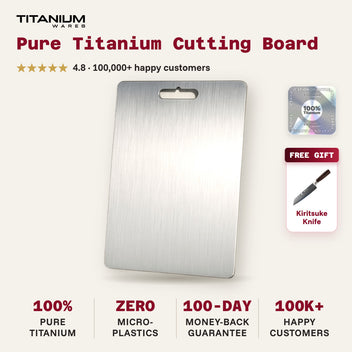
A pure titanium cutting board that never soaks up juices, stains or smells. Rinses clean or goes in the dis...
What Is a Plastic Cutting Board?
A plastic cutting board is molded from polyethylene or polypropylene. It is cheap to make, light to carry, and sold in every supermarket. For decades it was the default recommendation for raw meat, because it was easier to sanitize than wood.

The problem shows up with use. Knives cut into the surface and leave grooves. Those grooves hold moisture and residue, and they also mean the board is slowly giving up material. Some of that material ends up on your food.
Pros and Cons of Titanium Cutting Boards
In the titanium vs plastic cutting board matchup, titanium trades a small amount of knife comfort for a surface that does not degrade. Here is how that looks in practice.
Pros

- Non-porous, so juices sit on top instead of soaking in
- Sheds no plastic into food, even after years of cutting
- Does not stain from beets, turmeric or tomato
- Dishwasher safe with no warping
- Lasts decades instead of a year or two
Cons
- Costs several times more upfront than a plastic board
- Firmer under the knife, so you hone a little more often
- Shows cosmetic knife marks over time
- Harder to find in physical shops
Those knife marks are worth a word, because people assume they work like plastic grooves. They do not. We explain the difference in Are Scratched Titanium Cutting Boards Safe?
Pros and Cons of Plastic Cutting Boards
Plastic is not a bad material. It is a cheap one, and in a titanium vs plastic cutting board comparison it behaves exactly like a cheap material should: fine at first, worse every month.
Pros
- Cheapest board you can buy
- Very light and easy to store
- Gentle on knife edges
- Easy to replace when it wears out
- Comes in colors, which helps separate raw meat from produce
Cons
- Develops knife grooves that trap residue a wash cannot reach
- Sheds microplastic particles into food as it wears
- Stains permanently from pigmented foods
- Warps and softens at high dishwasher temperatures
- Needs replacing every one to three years
Titanium vs Plastic Cutting Board: Key Differences

The two materials separate on almost every measure that matters. Here is the titanium vs plastic cutting board comparison in one view, then the detail behind each line.
| FACTOR | TITANIUM | PLASTIC |
|---|---|---|
| Construction | Single sheet of Grade 1 titanium | Molded polymer |
| Lifespan | 10 to 30+ years | 1 to 3 years |
| Absorbs residue | No | Yes, in knife grooves |
| Adds plastic or chemicals | No | Yes, microplastics |
| Knife feel | Firm | Soft, gentle on edges |
| Dishwasher | Yes, any cycle | Sometimes, can warp |
| Upfront price | Premium | Cheapest |
Material and Construction
Titanium is a pure metal pressed into one flat sheet. There is no glue, no resin, no coating and no second material anywhere in it. What you see is what the whole board is made of.
Plastic boards are molded polymer. The material is soft enough that a knife cuts into it rather than sliding across it, which is why plastic feels kind to blades and also why it wears.
Durability and Lifespan
A plastic board has a visible end of life. The grooves deepen, the surface goes cloudy, and at some point it is obviously time to throw it out. Most households do that every one to three years.
Titanium does not have that moment. It will not warp, crack, split or rust. The surface picks up marks, but the board itself stays flat and usable for decades. We put real numbers on it in How Long Does a Titanium Cutting Board Last?
Hygiene and Food Safety

This is the heart of the titanium vs plastic cutting board question. A fresh plastic board is easy to clean. A used one is not. Knife grooves hold moisture and food residue in places a sponge cannot properly reach, which is why food safety guidance tells you to replace heavily scored boards.
Titanium has no grain and no grooves to open up. Chicken juice sits on the surface until you rinse it away, which makes it a bacteria resistant surface for raw protein even after years of use.
There is a second half to this. Studies have measured plastic particles coming off boards during normal chopping. Titanium does not shed anything, and we go through why in Are Titanium Cutting Boards Non-Toxic?
Knife Friendliness
Plastic wins here, and it is the only category where it clearly does. A soft surface gives under the blade, so edges stay sharp a little longer.
Titanium is firmer. You will hone more often, though far less often than you would on glass or stone. For most home cooks the difference is a few extra passes on a honing rod each month.
Weight and Portability
Both boards are easy to carry, and a thin plastic board is the lighter of the two. Titanium is roughly 43 percent lighter than steel by volume, so it stays comfortable to lift even in the large size.
Storage is where titanium pulls ahead. A plastic board that has warped in the dishwasher no longer sits flat on the counter or stacks cleanly in a cupboard. Titanium stays flat permanently.
Price Comparison
Plastic costs a few dollars. Titanium costs several times that. On the shelf it is not a close contest.
Spread it across time and the picture flips. Five or six plastic boards over a decade adds up, and you are buying the same problem each time. One titanium board covers the same decade and keeps going.
Environmental Impact
Every plastic board you throw out is a board that has to be made again. The worn ones also release particles into food and into the water system while you use them.
Titanium is recyclable and, more usefully, rarely needs recycling. A board that lasts thirty years is thirty years of boards not manufactured and not thrown away.
Titanium vs Plastic Cutting Board: Which One Is Better?
For almost every home kitchen, the titanium vs plastic cutting board answer is titanium. It is cleaner after years of use, it does not put anything into your food, and it does not need replacing. Plastic is the right answer only when budget is the deciding factor today.
The honest caveat is knife feel. If you own expensive Japanese knives and you want the softest surface available, plastic and wood both beat titanium on that single measure. We cover exactly how much in Do Titanium Cutting Boards Dull Knives?
If you are also weighing wood as an option, the same comparison against a natural material is in Titanium vs Wooden Cutting Board
Shop The Best Quality Titanium Cutting Board At Titanium Wares

Plenty of listings use the word titanium. Fewer tell you the grade. Every Titanium Wares Titanium Cutting Board is made from Grade 1 food-safe titanium, with no coating, no resin and no filler. Each one is SGS-tested, so the material claim comes with paperwork behind it.
The boards come in small, medium and large. One size covers daily prep for most households. Two lets you keep raw meat and produce on separate surfaces. The finish stays smooth, rinses clean in seconds and handles the dishwasher without complaint.
Conclusion
So which wins the titanium vs plastic cutting board comparison? Titanium, on everything except price and a small amount of knife comfort. It stays clean after years of use, it sheds no plastic into your food, and one board outlasts five or six plastic ones.
Plastic still makes sense if you need a board today and money is tight. For everyone else, the Titanium Wares titanium cutting board is the upgrade that ends the replacement cycle for good.
For more helpful kitchen tips, follow us on Facebook and Instagram! If you have any questions about Titanium Wares products or promotions, contact us anytime at support@titaniumwares.com. Our 24/7 team is always happy to help.
Frequently Asked Questions
Which is better in a titanium vs plastic cutting board comparison?
Titanium, on hygiene, lifespan and food safety. Titanium is non-porous and sheds no plastic, while plastic develops knife grooves that hold residue and releases small particles into food as it wears. Plastic is cheaper and slightly gentler on knives, and those are its only real advantages.
Do plastic cutting boards really shed microplastics?
Yes. Research has measured plastic particles coming off boards during normal chopping. The amount depends on how hard the board is used and how worn the surface already is. A titanium board has no plastic in it, so the question does not apply.
Does a titanium cutting board dull knives faster than plastic?
Slightly, yes. Plastic is softer and gives under the blade. Titanium is firmer, so you hone more often. It is still far gentler than glass, stone or ceramic, and it will not chip a well-made edge.
How often should you replace a plastic cutting board?
Most households replace one every one to three years, or sooner once deep knife grooves appear. Those grooves are the signal, because a wash can no longer reach everything inside them.
Is a titanium cutting board worth the extra cost over plastic?
Over a decade, usually yes. In a titanium vs plastic cutting board cost comparison, five or six plastic boards cost more in total than one titanium board that keeps going for twenty or thirty years. The value only shows up if you keep it, which most people do.

