 Cutting Board
 Frying Pan Pro
 Double-Sided Board


Plastic cutting boards are in almost every kitchen because they’re light, cheap, and easy to rinse. But every slice leaves a mark, which raises a fair question: are plastic cutting boards safe for daily food prep? Recent research shows knives can shave tiny plastic particles off the board and into your food. In this article, Titanium Wares explains what that means for your health, how plastic compares with other materials, and which plastic-free alternatives are worth considering.
In this article
Key Takeaways
-
Plastic cutting boards can be used safely when they're food-grade, cleaned well, and replaced once deeply scarred.
-
A 2023 study in Environmental Science & Technology found that chopping on polyethylene and polypropylene boards releases microplastics into food.
-
Research on how microplastics affect human health is still developing, so limiting avoidable exposure is a sensible precaution.
-
BPA-free means a board lacks one specific chemical; it does not mean the board is plastic-free.
-
Wood, bamboo, stainless steel, and titanium are all plastic-free cutting board options, and the Titanium Wares 100% Pure Titanium Cutting Board stands out for its non-porous, low-maintenance surface.
Are Plastic Cutting Boards Safe?
In short, yes, with conditions. A food-grade plastic board that's cleaned properly and replaced on time can still have a place in your kitchen. The real issue is how it ages.
A new plastic board has a smooth, even surface. After months of use, it's covered in knife scars. Those grooves can trap tiny food scraps and moisture, and bacteria can linger there if the board isn't scrubbed thoroughly. Deep cuts are also harder to reach with a sponge.
Then there's the label. Many boards are marketed as BPA-free, which sounds reassuring. But BPA-free only means the board doesn't contain bisphenol A, one specific chemical. It's still plastic, it still wears down, and it can still shed particles when you cut on it.
So a BPA-free board isn't the same as a plastic-free board, and it doesn't rule out every chemical or microplastic concern. That difference matters most if you're trying to reduce plastic contact in your kitchen, which brings us to the bigger question.
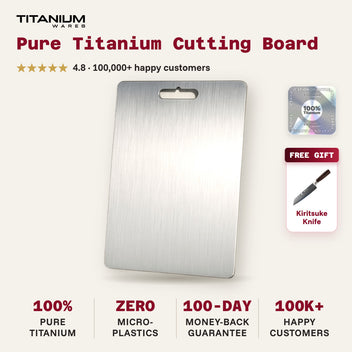
A pure titanium cutting board that never soaks up juices, stains or smells. Rinses clean or goes in the dis...
Do Plastic Cutting Boards Release Microplastics?
Yes. Research shows they do, and the amount adds up over a year.
Microplastics are plastic fragments smaller than 5 millimeters. Some form when larger plastic items break apart over time. Others are created by everyday friction, like a knife striking a board.
Every cut works like a tiny scraper. The blade presses into the surface, carves a groove, and loosens small flakes of plastic. Some of those flakes stick to the food you're chopping.
A 2023 study led by researchers at North Dakota State University, published in Environmental Science & Technology, measured this directly. Participants chopped carrots on polyethylene (PE) and polypropylene (PP) boards. The team estimated that one person could be exposed to about 14.5 to 71.9 million PE microplastics a year, or about 79.4 million PP microplastics. By weight, that's roughly 7.4 to 50.7 grams a year from PE boards and about 49.5 grams from PP boards.
How much plastic comes off depends on a few factors:
-
Type of plastic: In the study, polypropylene released more particles than polyethylene.
-
Chopping frequency: The more often a board is used, the more it wears.
-
Knife and technique: Chopping style and cutting force both affected release. A dull blade usually needs more pressure.
-
Board condition: A heavily grooved surface has more loose, raised edges that can break away.
Most particles in the study were smaller than 100 micrometers. Even tinier fragments, under 1 micrometer, are called nanoplastics. They're harder to detect, and scientists are still working out how often cutting produces them.

Repeated chopping can wear down a plastic cutting board over time. A pure titanium board provides a plastic-free cutting surface without an applied coating.
What Are the Health Risks of Microplastics?
Microplastics don't simply pass through your plate. Researchers have found them in human lungs, the placenta, the liver, and even the walls of arteries. In other words, these particles can travel through the body and settle in it.
That raises a harder question: what are they doing once they're there?
One of the most talked-about answers came in 2024. A study in the New England Journal of Medicine followed 257 patients after surgery to clear a blocked neck artery. Those whose arterial plaque contained micro- or nanoplastics had a far higher rate of heart attack, stroke, or death over about three years: 20% versus 7.5%. The plastic found most often was polyethylene, one of the most common cutting board materials.

Scientific illustration of microplastics in the human bloodstream
That study shows a link, not proof of cause. Still, it adds weight to lab and animal research pointing to the same concerns:
-
Inflammation, as the body reacts to foreign particles.
-
Oxidative stress, an imbalance that can damage cells over time.
-
Accumulation, as some particles stay in tissue rather than leave the body.
Cancer is another worry. Many news reports and health articles have raised the possibility that long-term exposure to microplastics could play a role in cancer. Scientists are investigating, but no study has yet proven that microplastics cause cancer in people.
That uncertainty is exactly the point. The full risk isn't known yet, and microplastics already reach us through food, water, and air. Your cutting board is one source you can actually control. When practical plastic-free alternatives exist, there's little reason to keep adding plastic to every meal you prepare.
Plastic vs Other Cutting Board Materials Compared
Once you know plastic can shed particles, the natural next step is to see what else is available. Each material brings its own strengths, so here's a quick side-by-side look. For a deeper breakdown, see our guide to the best cutting board material.
|
Material |
Key Strengths |
Things to Consider |
|
Plastic |
Affordable, lightweight, easy to replace |
Can release microplastics as it's cut |
|
Wood |
Gentle on knives, warm natural look |
Needs regular oiling and careful drying |
|
Bamboo |
Lightweight, made from a fast-growing, renewable resource |
Strips are bonded with glue, and adhesive quality varies by maker, so check what's used |
|
Titanium |
Plastic-free, non-porous, corrosion-resistant |
Higher upfront price, built for long-term use |
|
Stainless Steel |
Plastic-free, non-porous, easy to clean |
Hard surface, heavy compared to titanium. |
No single board is perfect for every kitchen. The right choice depends on how you clean, how long you want a board to last, your budget, and how much you want to cut back on plastic. If you want one board that's plastic-free, non-porous, and never needs oiling, titanium checks every box.
Do Professional Chefs Use Plastic Cutting Boards?
Plastic boards are common in restaurant kitchens, often in color-coded sets: one color for raw meat, another for fish, another for produce. This makes it easier to prevent cross-contamination during a busy service.
But commercial kitchens also follow strict routines. Boards are sanitized constantly, and worn ones are swapped out as soon as the surface breaks down. Plastic fits that setting because it's cheap to replace in bulk.
That doesn't make it the best fit for every home. Most households replace boards far less often, and many home cooks weigh things a busy restaurant may not, like reducing plastic contact or owning one board that lasts for years.
Should You Throw Out Your Plastic Cutting Board?
You don't need to throw out a perfectly usable cutting board overnight. But if yours is heavily scratched, difficult to clean, or you're looking to reduce plastic contact with your food, switching to a plastic-free surface is a practical next step.
Replace it when you notice deep grooves, cracks, warping, or stains and odors that won't wash out. Don't wait until it's falling apart.
If you'd like to cut back on plastic for the long term, this is a good moment to switch. A pure titanium cutting board has no plastic to wear away. Titanium Wares also offers free shipping and a 100-day money-back guarantee, so you can try it in your own kitchen before deciding.
How to Use a Plastic Cutting Board More Safely
If you're keeping your plastic board for now, a few habits make a real difference.
-
Use separate boards: Keep one for raw meat and fish, and another for fruits, vegetables, and ready-to-eat foods.
-
Wash it right after use: Scrub with hot, soapy water, paying close attention to knife grooves, then rinse well.
-
Use the dishwasher if allowed: Many plastic boards are dishwasher-safe, but check the manufacturer's instructions, since high heat can warp some boards.
-
Retire damaged boards: Deep grooves, cracks, and rough patches are harder to clean, so stop using a board once its surface breaks down.
-
Replace by condition, not by calendar: There's no fixed lifespan. How often you cook and how you clean matter more than how old the board is.
-
Dry it before storing: Stand it upright or let it air-dry fully so moisture doesn't linger.
For material-by-material tips, read our guide on how to clean a cutting board.
These habits go a long way toward handling food residue and bacteria. What they can't do is stop the surface from wearing down, because every cut still scrapes away a little plastic. If that's the part that concerns you, the lasting fix is a different material.
The Best Plastic-Free Cutting Board Alternatives
Ready to move away from plastic? You have several good options, and each suits a different cooking style.

Comparison of plastic wood bamboo titanium and stainless steel cutting boards
Wood and Bamboo Cutting Boards
Wood and bamboo are classic plastic-free choices. Wood is gentle on knife edges and adds natural warmth to the countertop. Bamboo is lightweight and grows quickly, which makes it a popular eco-friendly, sustainable pick.
Both need a little care. Wash them by hand, dry them promptly, and oil them from time to time to prevent cracking. Bamboo boards also deserve a closer look before you buy: they're made from strips bonded with glue, and not every adhesive is the same quality, so check what the maker uses. Bamboo is fairly hard, too, so it can be tougher on blades than most woods.
Stainless Steel Cutting Boards
Stainless steel offers a plastic-free, non-porous surface, so it doesn't shed microplastics as you cut. It's quick to clean, resists corrosion, and usually costs less than titanium, which makes it an easy entry point into metal cutting boards.
The main trade-off is weight. Stainless steel boards are fairly heavy, which can make them less convenient to lift, carry to the sink, or store, especially in larger sizes.
Titanium Cutting Boards
If you want to get plastic off your cutting surface for good, the Titanium Wares 100% Pure Titanium Cutting Board is built for that. It is a single sheet of solid Grade 1 titanium, with no coating and no plastic layer underneath, and it brings together advantages you rarely find in one board.
- Pure material: The Titanium Wares board is made from 100% Grade 1 commercially pure titanium and is SGS-tested for food contact. Stainless steel is an alloy of iron, chromium, and other metals, but this board is essentially one metal, so you know exactly what touches your food.
- No coating: The titanium itself is the cutting surface. There is no added layer that can peel, flake, or wear away into your meals after months of chopping.
- Lighter in the hand: Titanium weighs about 40% less than stainless steel of the same size. A metal board you would expect to be heavy is easy to lift, rinse, and put away.
- Built to resist corrosion: Titanium naturally forms a protective oxide layer on its surface. It handles daily washing, moisture, and acidic foods like lemon and tomato without rusting or reacting.
- Simple care: The non-porous surface keeps meat juices and odors on top instead of letting them soak in, so one board can go from meat and fish to vegetables and fruit after a quick wash. Clean it with soap and warm water or run it through the dishwasher. There is no oiling, no sanding, and no warping.
- Options for every kitchen: The board comes in Small, Medium, and Large sizes, or as a 3-piece set so you can give raw meat and fresh produce their own boards. If you would rather keep things to one board, the Titanium Wares double-sided cutting board gives you two separate surfaces, one for raw proteins and one for ready-to-eat foods, in a single board that takes up less counter space.
Wood is comfortable under the knife, and stainless steel is affordable. Titanium’s strength is that it combines the benefits that matter most in one board: plastic-free, lightweight, hygienic, and low-maintenance through years of daily prep.
Want to see how it holds up against the board you're replacing? Read our side-by-side guide: titanium vs plastic cutting board.
If you want a cleaner, simpler way to prep every day, take a closer look at the Grade 1 titanium cutting board by Titanium Wares.

Fresh salmon being sliced on a thin, brushed titanium cutting board with lemon and herbs in a modern kitchen.
Conclusion
Are plastic cutting boards safe? With good habits, they can be. But research shows they shed microplastics as you cut, and scientists are still learning what that means for long-term health.
There's no need to panic or toss a good board today. Keep it clean, replace it when it's worn, and when the time comes, consider a plastic-free upgrade. If you're looking for a cleaner and simpler way to prepare food every day, the Titanium Wares Pure Titanium Cutting Board, along with its convenient double-sided version, is just what you need.
For more helpful kitchen tips, follow us on Facebook and Instagram! If you have any questions about Titanium Wares products or promotions, contact us anytime at support@titaniumwares.com. Our 24/7 team is always happy to help.
FAQs
Are plastic cutting boards BPA-free?
Many are, since common board plastics like polyethylene and polypropylene aren't made with BPA. But BPA-free isn't the same as plastic-free. A BPA-free board is still plastic and can still shed microplastics when cut.
Do plastic cutting boards release microplastics?
Yes. A 2023 study in Environmental Science & Technology found that chopping on polyethylene and polypropylene boards releases microplastics into food. The amount depends on the plastic type, chopping style, and how worn the board is.
What is the best alternative to plastic cutting boards?
Wood, bamboo, stainless steel, and titanium are all plastic-free options. Wood is gentle on knives but needs regular oiling, while stainless steel is non-porous and affordable but fairly heavy. Titanium combines a non-porous, lightweight surface with no oiling and dishwasher-safe cleanup, which makes the Titanium Wares 100% Pure Titanium Cutting Board a strong everyday choice.
How often should you replace a plastic cutting board?
There’s no fixed timeline, because wear depends on how often you cook and how you clean. Replace the board once it has deep grooves, cracks, warping, or stains and odors that won’t wash out. A heavily scarred surface is harder to clean and can shed more plastic particles as you cut.

